
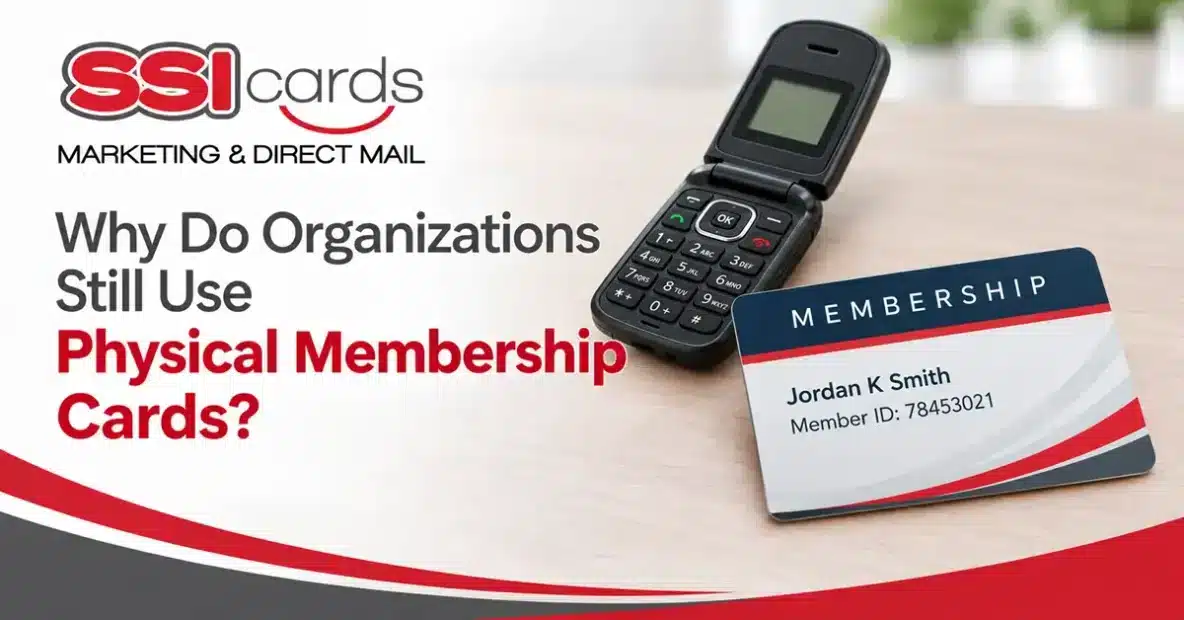
Quick Answer
Organizations still use physical membership cards because they provide tangible proof of membership, work without a smartphone, support in-person identification, and make benefits easier to access. They also give members a lasting reminder of their affiliation. Many organizations pair physical cards with digital credentials so members can choose the format that works best for them.
Key Points
- Physical cards work without apps or internet access and accommodate growing interest in “dumb phones.”
- They support identification, reciprocal benefits, and member recognition.
- Personalized card mailings create opportunities for onboarding, renewals, and winback campaigns.
- Digital credentials complement physical cards through immediate delivery and convenient updates.
- Card design, material, personalization, and delivery contribute to the member experience.
Why Physical Membership Cards Have Outlasted the Digital Shift
Physical cards continue to serve needs that digital delivery alone does not address. Members may need to identify themselves at a front desk, claim partner benefits, or carry a credential without depending on a device.
For U.S. membership organizations, retaining physical cards is a practical decision tied to member preferences, program benefits, and everyday operations.
Six Reasons Organizations Still Use Physical Membership Cards
- They Make Membership Feel Tangible
A physical card gives members something they can hold, carry, and present. Receiving it marks the start of the relationship and makes enrollment more concrete than an online confirmation.
For professional associations, alumni groups, clubs, and cultural institutions, the card becomes a recognizable symbol of affiliation. Tier-specific colors, distinctive artwork, and personalized details reinforce that recognition.
Gift memberships also benefit from a physical presentation. A card delivered with a welcome message gives the recipient something to open, keep, and use.
- They Work Without a Phone
A physical card does not depend on battery life, a mobile app, a login, or an internet connection. Members can present it when their phone is unavailable or they prefer not to use it.
That simplicity matters at busy events, outdoor facilities, and partner locations. Staff can inspect a name, photo, membership level, or expiration date without asking members to navigate a device.
Clear typography and consistent information placement make cards easier to check. Barcodes can also connect credentials to existing check-in processes.
- They Support Reciprocal Benefits and Partner Access
Reciprocal membership programs provide benefits at participating organizations beyond a member’s home institution. A physical credential helps members demonstrate eligibility at those locations.
For example, the Association of Science and Technology Centers (ASTC) Passport Program lets members of participating science centers and museums receive admission benefits at eligible partner institutions. Members are instructed to bring their membership cards, with benefits subject to location restrictions and each institution’s admission policies.
Local merchant discounts work similarly. Clearly displayed organization names and membership details help businesses recognize qualifying customers without integrating with an unfamiliar app.
- They Accommodate Different Member Preferences
Not every member wants another app or digital wallet pass. Some prefer a familiar wallet card, while others want a non-digital option available when needed.
Some consumers are also choosing “dumb phones” to reduce screen time. Physical membership cards let them access benefits without relying on smartphone apps or digital wallets.
Pew Research Center’s mobile fact sheet tracks smartphone ownership across U.S. adults and demographic groups. Widespread adoption does not mean every member wants to depend on a phone for every interaction.
Household memberships also benefit from separate credentials for authorized family members or caregivers. Each person can carry proof of eligibility without relying on someone else’s device.
- They Keep the Organization Visible
A membership card provides recurring exposure to the organization’s name and branding. Members see it when opening a wallet, presenting it at a venue, or reaching for a key tag.
Card delivery creates another useful touchpoint. A welcome package can introduce benefits, explain reciprocal admission, and direct members to events or online resources.
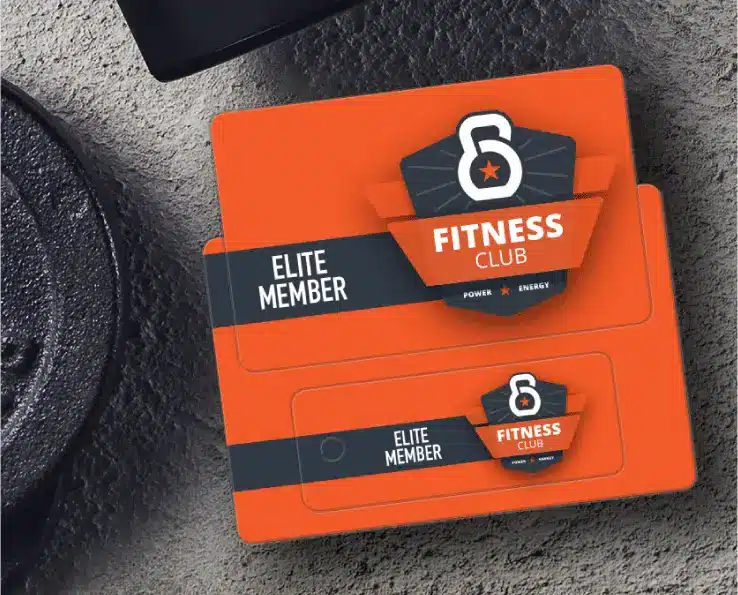
A gym membership card and branded key tag combine convenient check-in with ongoing brand visibility.
ASAE’s member onboarding guidance emphasizes providing value immediately and helping new members build connections. A well-planned card mailing supports those goals with relevant information and clear next steps.
- They Help Staff Recognize Authorized Members
Names, membership levels, expiration dates, and unique member numbers help staff confirm eligibility and apply the correct benefits. A clearly displayed membership level identifies available privileges, while a member number connects the card to organizational records.
Protect personal information throughout the process. Print only necessary details, use secure file transfer, restrict production-file access, and verify that personalized credentials reach the correct recipients. Establish a straightforward replacement process for lost cards.
How Different Organizations Use Physical Cards
| Organization type | Common card uses |
| Museums, zoos, and cultural institutions | Family admission, gift memberships, and reciprocal benefits |
| Gyms and recreation facilities | Front desk check-in and member verification |
| Professional associations | Member recognition, conference identification, and event eligibility |
| Credit unions and cooperatives | Member recognition and service identification alongside required verification procedures |
| Country clubs, social clubs, and alumni groups | Membership tiers, guest privileges, and member-only benefits |
| Retail and warehouse programs | Membership checks at entry, service counters, or checkout |
For membership-based organizations, the strongest card program reflects actual interactions rather than adding features members rarely use.
Turning Card Delivery Into Renewal and Winback Outreach
A membership mailing can welcome new members, encourage participation, prompt renewals, or reconnect with former members. The credential supplies identification; the accompanying message explains why and how to participate.
Research from the USPS Office of Inspector General and Temple University, published in Enhancing the Value of Mail: The Human Response, found that physical advertising produced stronger emotional responses and better delayed recall than digital advertising. The findings support the inclusion of tangible communication in a broader engagement strategy.
Match the Mailing to the Member
New members need benefit explanations and instructions. Current members may need renewal reminders or information about benefits they have not used. Former members may respond to an incentive to return.
Integrated Membership Card Mailers have become the standard for membership card mailings. They combine personalized credentials with space for welcome information and salutations, benefit explanations, or renewal messaging. Integrating the card, carrier, and personalized salutations into one piece increases efficiency and eliminates the need for match printing and affixing a separate card to a carrier. This eliminates the risk of pairing a member’s card with another person’s letter or mailing it to the wrong recipient because of a card-to-letter mismatch.
The integrated mailer is inserted into a standard window envelope, with the recipient’s address visible through the window. Its 30 mil card construction adds rigidity, making the unopened envelope impossible to tear in half and encouraging recipients to open it rather than instinctively discard it. Organizations that switch to this format report fewer members saying their cards never arrived.
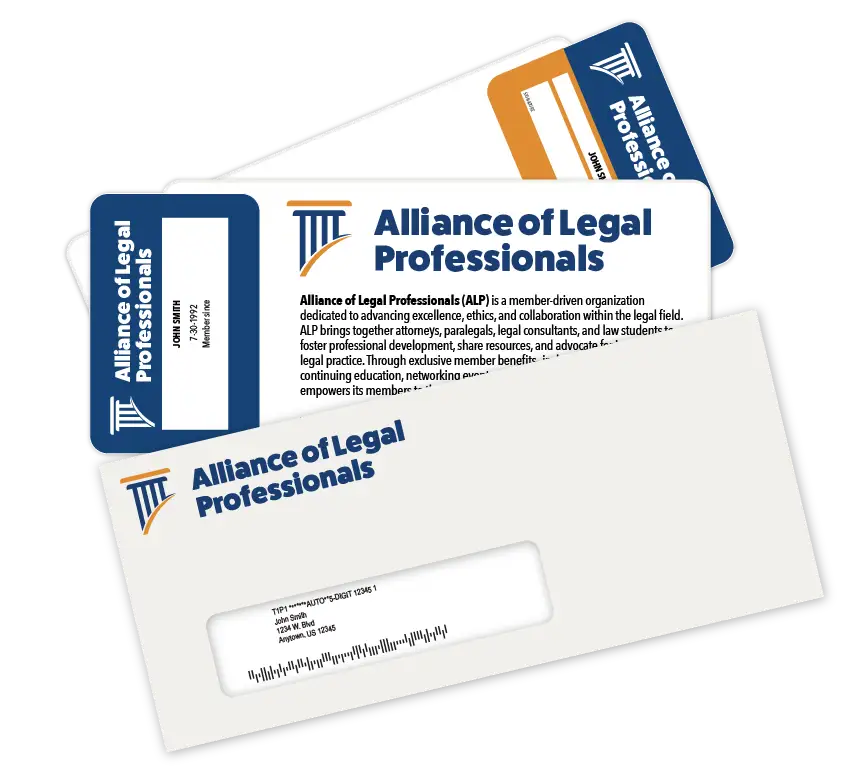
Integrated membership card mailer for a legal association, shown with a #10 windowed envelope. The address on the mailer’s body drives the mailing through the window.
Use Retainable Offers for Reactivation
Promotional mailers serve a different purpose from credentials: they communicate offers and encourage response.
AcclaimMailer™ is a polyester plastic postcard with durable break-off cards designed to mimic the look and feel of gift cards. The wallet-friendly cards help recipients retain an offer beyond the initial mailbox interaction and carry it for a future visit.
Two SSI Cards campaigns illustrate the opportunity:
- A regional grocer’s five-year campaign averaged a 25% redemption rate against a 10% goal, using a $20-off-$50 offer to reach declining and lost shoppers.
- A 40-location Midwest car wash campaign generated 16,505 redemptions and 1,129 new memberships, with a reported 453% realized ROI over four months.
Planning a credential mailing or winback campaign? Request a quote to explore formats suited to your audience and objectives.
Choosing Membership Card Materials
Choose materials based on intended use, expected handling, required features, and environmental priorities.
SSI Cards’ Teslin® Membership Cards and Badges are favored for their long life and durability. They are 20-30 mil thick, depending on the application, and contain zero PVC (Greenpeace describes PVC as “the single most environmentally damaging of all plastics”).
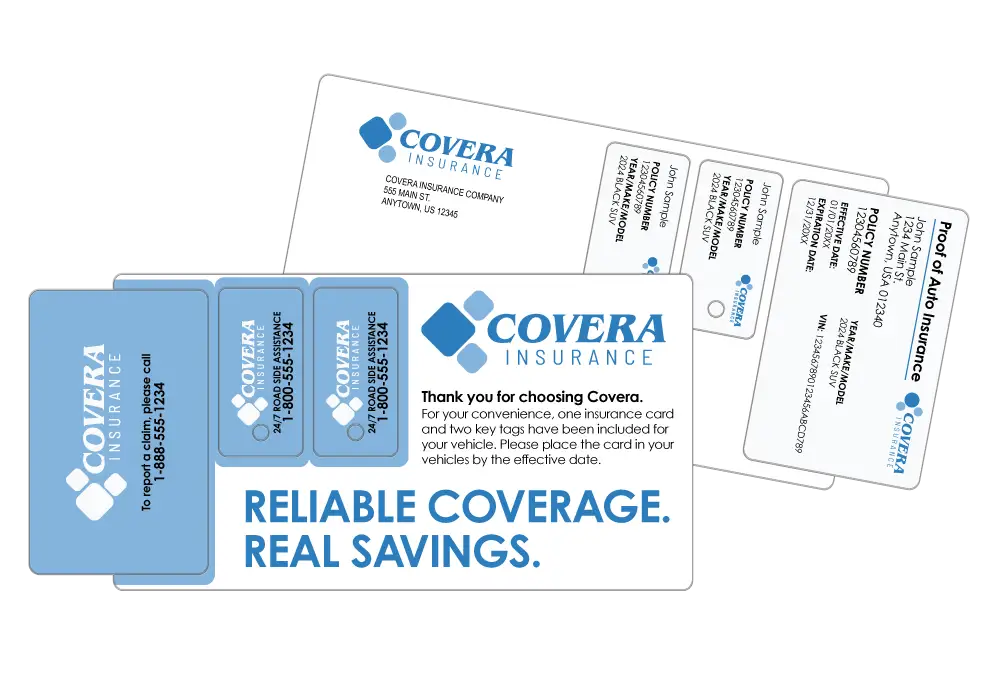
Auto insurance integrated mailer featuring one card and two durable Teslin key tags.
SSI Cards’ NVIO™ card is a landfill-biodegradable solution, again with zero PVC, that can be paired with a variety of substrates, including Bio Teslin for a durable construction. NVIO has been tested to ASTM D5511-18 and ISO 15985 by an ISO/IEC 17025-accredited laboratory.
Managing Costs and Pairing Physical Cards With Digital Options
Physical cards require production, personalization, delivery, and occasional replacement. Evaluate those costs against the functions they perform, including identification, benefit delivery, onboarding, and renewal communication.
A hybrid program connects physical and digital credentials to the same membership record. Organizations can issue a digital pass immediately after enrollment, then mail a physical card with welcome information.
To keep the program efficient:
- Use consistent branding and member identifiers across formats.
- Explain which credentials staff and partner locations accept.
- Consider non-dated cards when current eligibility can be verified through membership records.
- Provide clear instructions for replacing lost credentials.
- Offer physical cards automatically, by preference, or according to membership tier.
A QR code on the carrier can direct members to a portal or mobile wallet enrollment instructions.
For a fuller comparison, see Are Physical Membership Cards Still Relevant?.
Questions to Ask Before Launching
Before selecting specifications and a mailing approach, confirm:
- Where members present credentials and which partners expect them.
- Which formats best fit your members’ preferences.
- Which personalization details and barcode formats are needed.
- The full cost of production, postage, fulfillment, and replacements.
- Applicable security and privacy requirements.
- How you will measure benefit use, satisfaction, renewals, or campaign response.
These answers turn a card purchase into a defined program with clear operational and communication goals.
Frequently Asked Questions
Do Members Prefer Physical or Digital Membership Cards?
Preferences vary by audience and use. Physical cards suit members who want a tangible credential without relying on a phone, while digital cards offer convenient mobile access. Offering both accommodates different preferences.
Do Reciprocal Programs Require a Physical Card?
Some programs require members to present a valid membership card to receive reciprocal benefits. A physical card gives members a convenient way to demonstrate eligibility at participating locations.
Can Organizations Offer Both Physical and Digital Cards?
Yes. Organizations can issue a digital credential at enrollment and provide a physical card by mail or on the spot. Supermarkets, gyms, and other loyalty programs often use branded, barcoded key tags for convenient check-in or checkout while keeping their brand visible. Consistent branding and matching member identifiers connect the physical and digital experience.
How Can Organizations Justify the Cost?
Connect spending to specific functions, such as identification, partner benefits, onboarding, and renewal outreach. Track cost per issued card alongside usage, feedback, campaign response, and renewal results.
What Should Be Printed on a Membership Card?
Include the organization name, member name or number, and information needed to verify eligibility. Add a photo, tier, barcode, or QR code when useful, while avoiding unnecessary sensitive personal data.
What PVC-Free Membership Card Options Are Available?
Laminated Teslin® cards provide a durable, PVC-free option. NVIO™ is a landfill-biodegradable card solution that can be paired with Bio Teslin. Select the construction based on durability requirements and environmental goals. Paper cards laminated with polyester offer another option, adding durability beyond standard paper cards.
Plan Your Membership Card Program
Physical cards perform practical jobs while making membership visible and tangible. The right design, material, personalization, and delivery method support daily operations and ongoing member communication.
SSI Cards manufactures and personalizes membership cards, rewards and loyalty key tags, and card mailers, with mailing options for organizations that want production and fulfillment through one source.
Request a quote to discuss your membership card requirements.
By Sean Goade
Executive VP | SSI Cards Marketing & Direct Mail
About the Author
Sean Goade specializes in helping businesses and membership organizations leverage high-impact direct mail, membership cards, gift cards, loyalty cards and key tags, and personalized marketing solutions to support engagement, retention, and growth.