
Key Points
- AI improves direct mail by using existing CRM data to select the best message, offer, image, or timing.
- AI does not create customer data; it analyzes what the business already has.
- Variable data printing and variable image printing turn AI-assisted decisions into physical mail.
- AI does not guarantee higher response rates. Results still depend on targeting, offer, creative, timing, and format.
- High-retention formats can help a personalized offer stay visible and useful longer.
- Test AI-assisted targeting against a control group before scaling.
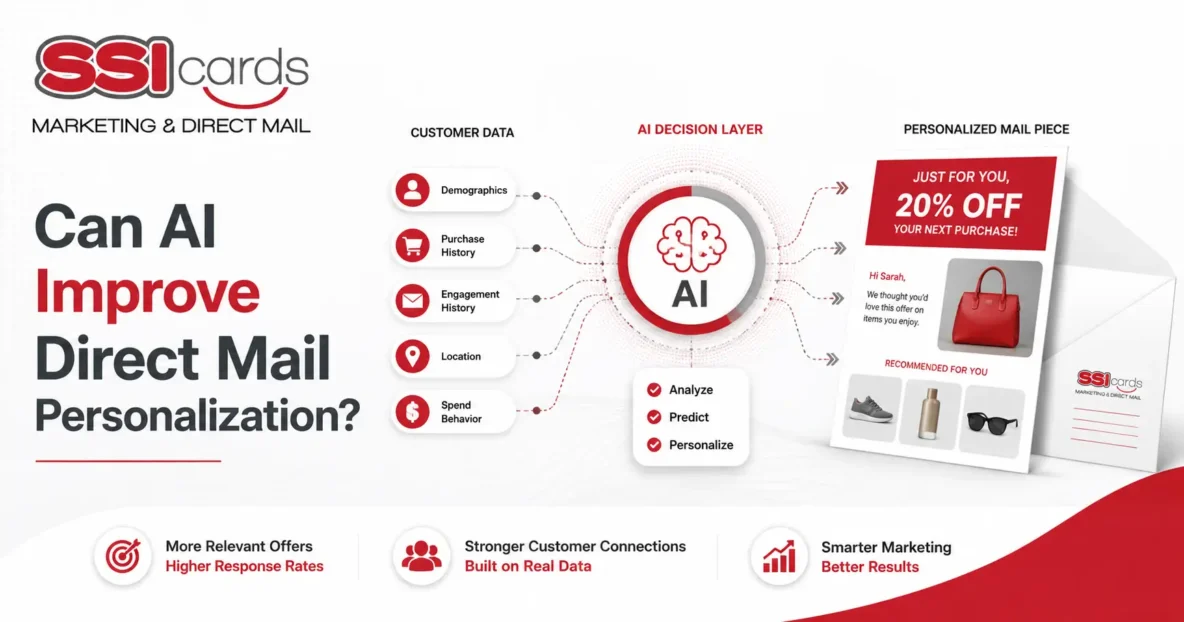
Yes. When a business already has customer information and purchasing behavior in a CRM, AI can help turn that data into more relevant direct mail. The key point is that AI does not create the underlying customer record. It uses the information the business already has to help identify the best message, product, image, or offer for each recipient.
In practice, that information flows into variable data printing, variable image printing, and automated or triggered mailings. USPS also notes that direct mail works best when it is connected to broader marketing activity, not treated as an isolated channel.
For a U.S. marketer, the question is not whether AI sounds advanced. The question is whether it makes the mail piece more relevant and more likely to be kept, noticed, and used. When it does, it can improve response. When it does not, it is just extra complexity.
What personalization means in direct mail today
Direct mail personalization has three common levels:
- Basic mail merge: the piece changes only by name and address.
- Variable data printing: the offer, short copy, or image changes according to a rule or segment.
- AI-assisted personalization: the system helps choose the most relevant version based on customer behavior, purchase history, and other CRM signals.
USPS encourages marketers to know their audience and use data to understand habits, preferences, values, and concerns. Its direct mail guidance also says consumers expect tailored, relevant marketing. That is why personalization matters before AI even enters the picture.
The core workflow
The practical workflow is straightforward:
- CRM data already exists inside the business.
- AI helps identify the best message, product, and image for each recipient.
- The selected content becomes a personalized postcard or mail piece.
- The piece is printed and mailed.
That means the AI is acting as a decision layer, not a data-creation layer. The business still owns the source data. The mail provider uses that data to build the variable file and execute the campaign.
For variable image mailings, the images themselves need to already exist in the business’s approved asset library so the system can select among them. AI can help map the right asset to the right person, but it cannot invent the customer’s purchase history or browse behavior.
Where AI fits
AI is most useful before the mail is printed. It can help clean up segmentation, find patterns that are hard to spot manually, and reduce the need to build dozens of rigid rules by hand.
That matters because direct mail still depends on good targeting. USPS says direct mail can be seamlessly connected to digital channels and that these integrated campaigns can generate additional consumer impressions, interactions, and insights. USPS Delivers says direct mail can stay in households for an average of 17 days and can be paired with digital touchpoints such as personalized URLs, QR codes, and a preview image in the mailbox. 17 days is good, but not all direct mail formats are created equal. For example, one 40-location car wash campaign generated 450% ROI and kept driving new membership sales for four months after the initial mailing, helped in part by the wallet-friendly, keepable offer format of AcclaimMailer™.
Segmentation and timing
This is one of the best uses of AI in direct mail. Instead of mailing everyone the same creative, AI can help separate the file into more useful groups, such as:
- customers whose purchase frequency is dropping.
- households showing signs of a new life stage.
- geographic clusters with higher likelihood to respond.
- loyal buyers who deserve a different offer than first-time customers.
The result is tighter targeting and less waste. USPS’s direct mail guidance reinforces this idea by telling marketers to target who matters and make customers feel special. That is exactly where AI can help when the data is strong.
AI can also help choose when to send and what to send. For example, one customer may respond better to a weekday offer, while another may respond better to a product reminder tied to a seasonal need. The value is not in making the mail sound futuristic. The value is in matching the message to the customer more closely.
Does it improve response?
It can, but only when the personalization is relevant. There is no automatic lift just because AI is involved. The lift comes from better list selection, better offer selection, and better timing.
USPS research says physical ads are more effective than digital ads in leaving a lasting impression across age groups, and USPS Informed Delivery can help pair direct mail with digital touchpoints such as personalized URLs, QR codes, and a preview image in the mailbox.
That is the real point. AI can sharpen the decision, but the printed piece still has to earn attention.
Where it falls short
AI is powerful, but it is not a fix for weak data or poor execution. Important limits include:
- clean CRM data is still required.
- variable image programs still need approved image assets.
- print production and mailing deadlines still apply.
- more personalization can mean more proofing and more version control.
- privacy obligations still matter when businesses use customer data for targeting.
The Federal Trade Commission advises businesses to understand the personal information they hold, limit collection to what they need, protect the information they retain, and have a plan for security incidents. The California Consumer Privacy Act (CCPA) gives consumers rights to know, delete, and opt out of the sale or sharing of personal information.
So the message is not “AI makes privacy concerns disappear.” The message is “use AI carefully, with the data you already manage responsibly.”
Where SSI Cards fits
SSI Cards can turn AI-assisted targeting into personalized, high-retention physical mail using CRM-derived segments, variable data, and variable images.
SSI Cards’ high-retention direct mail formats include:
- AcclaimMailer™, NVIO™, and AcclaimLite™ – high-retention gift card mailers with variable data, variable imaging, and wallet-friendly break-off cards. NVIO™ provides a biodegradable option for sustainability-focused campaigns; AcclaimLite™ offers gloss or matte paper postcard formats for simpler or more cost-conscious needs.
- Acclaim10™ – an elevated high-retention self-mailer that uses up to ten perforated break-out cards for incentives or coupon offers in one mailer.
- AcclaimFlex™ – a pay-as-you-go direct mail option for recurring, data-driven programs and steady trigger-based campaigns.
SSI Cards supports advanced personalization with data-driven variable graphics, messaging, and incentives. A couple of its customer case studies include a regional grocer with a 25% average redemption rate over five years and a car wash chain with a 450% ROI average across 40 locations. These are case-study results, not industry benchmarks, but they demonstrate what can happen when targeting, offers, creative, and a durable physical mail format work together.

- If the goal is repeated, data-driven mail without a large upfront ramp, AcclaimFlex™ is the cleanest fit.
- If the goal is maximizing the number of offer paths in one physical piece, Acclaim10™ is the better fit.
- If the goal is a durable, high-retention mailer designed to stand out from ordinary postcards and junk mail, AcclaimMailer™ is a strong fit. Its durable construction helps it arrive looking great despite the rigors of the mail stream, while its postcard-sized, gift-card-like feel and wallet-friendly break-off cards help increase retention and redemption.
For lifecycle or birthday campaigns, SSI Cards also offers birthday direct mail services, which can fit naturally into a CRM-triggered workflow.
How to get started
The best way to introduce AI into direct mail is through controlled testing rather than a wholesale change to an existing program.
- Start with a house list.
- Identify useful CRM signals.
- Define approved creative assets.
- Create personalized versions.
- Test against a control.
- Measure actual outcomes.
The goal is not to prove that AI is impressive. The goal is to determine whether AI improves the economics of the campaign.
Key takeaways
AI improves direct mail personalization when it helps a business use existing CRM data more intelligently. It can sharpen segmentation, improve message selection, and help match images and offers to the right recipient. It works best when the data is clean, the offer is strong, and the mail format is worth keeping.
For U.S. businesses, the practical approach is to start with existing CRM data, test AI-assisted personalization against a control group, and measure actual response and ROI. When that data-driven strategy is paired with a physical mail format that earns attention and remains useful after delivery, the two can reinforce each other.
FAQs
How is AI personalization different from traditional mail merge or VDP?
Traditional mail merge changes basic fields such as name and address. VDP can go further by changing offers, images, and copy according to predefined rules. AI-assisted personalization adds a decision layer that can analyze customer data and help determine which approved version is most relevant to each recipient or segment.
What role does AI play in variable data printing?
AI helps determine which text, offer, product, or image should be used. Variable data printing then executes those decisions by producing individualized versions of the mail piece. AI and VDP work together rather than replacing one another.
Can AI personalize direct mail beyond a name and address?
Yes. When sufficient CRM data is available, AI-assisted personalization can help determine different offers, images, products, or copy based on purchasing behavior, engagement, loyalty status, location, and other relevant signals.
Does AI-personalized direct mail get better response rates than standard mailings?
It can, but there is no guaranteed lift simply because AI is involved. Better performance comes from better targeting and more relevant offers. The most reliable way to determine whether AI is improving a campaign is to compare an AI-assisted strategy against a control group.
Is AI-driven personalization worth the added cost for small or mid-sized businesses?
It can be, particularly when the business already has useful customer data. The best candidates are businesses with enough customer history to support meaningful segmentation and a measurable conversion event. A controlled test can show whether the additional data work produces enough incremental revenue to justify the investment.
What data do you need to use AI for direct mail personalization?
The most useful starting point is existing first-party data, such as purchase history, product preferences, engagement, location, loyalty status, and purchase recency or frequency. AI uses available information to help make better targeting and personalization decisions.
Are there privacy or compliance concerns with AI-driven direct mail?
Yes. Businesses must handle customer information responsibly and comply with applicable privacy and data-protection requirements. AI does not remove those obligations. Businesses should collect and retain appropriate data, protect it, and honor applicable consumer rights and opt-out requirements.
What tools or services can support AI-assisted direct mail personalization?
A successful workflow generally requires customer data in a CRM or other business system, a process for analyzing that data and creating segments or personalization rules, and a print and mail operation capable of executing those decisions through VDP, variable image printing, and automated or triggered mailings. SSI Cards can support the physical execution of these data-driven campaigns through personalized direct mail formats and recurring or automated mailing services, depending on campaign requirements.
For businesses ready to evaluate a data-driven direct mail campaign, Request a Quote from SSI Cards.
By Sean Goade
Executive VP | SSI Cards Marketing & Direct Mail
About the Author
Sean Goade is Executive VP of SSI Cards Marketing & Direct Mail. He specializes in helping businesses leverage high-impact direct mail strategies, gift cards, and loyalty solutions to drive customer engagement, retention, and growth.