
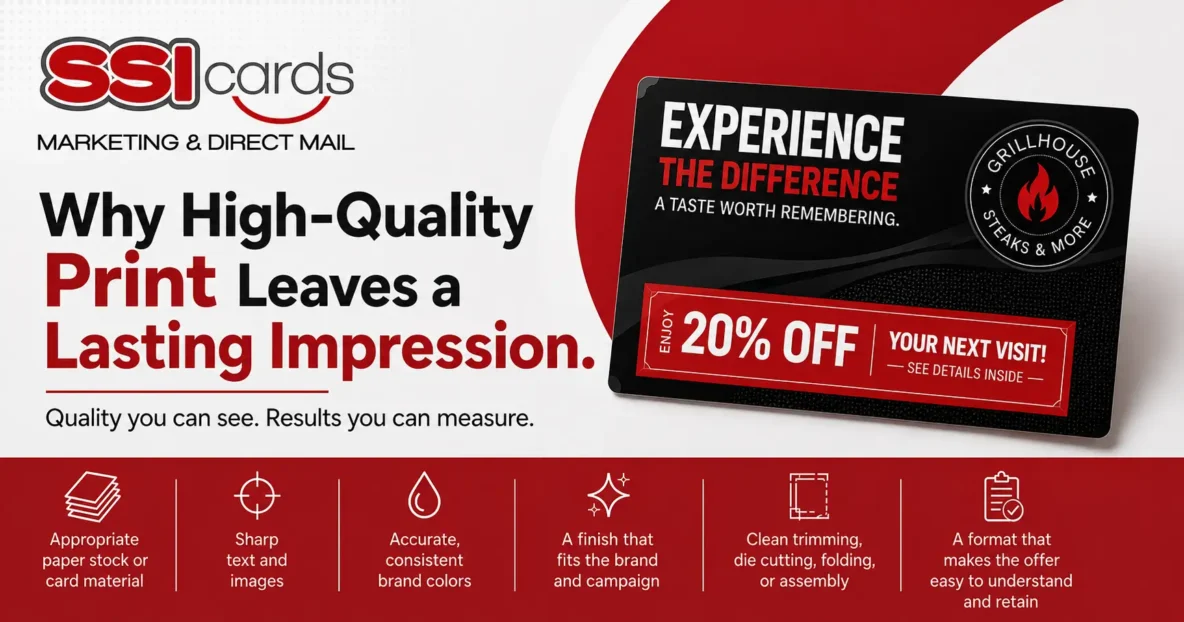
High-quality print affects how a direct mail piece is judged before a recipient reads the headline or considers the offer. Paper stock, weight, texture, color accuracy, print clarity, and finishing details can influence whether a piece feels credible, useful, and worth keeping.
For U.S. businesses, direct mail printing is part of the customer experience. A flimsy, blurry, poorly cut, smudged, or off-color mail piece can make a strong offer feel less reliable. A well-produced piece can make the same message feel more deliberate and consistent with the brand behind it.
High-quality printing does not mean every campaign needs specialty paper or expensive production. It means choosing the right material, printing method, and format for the audience, offer, campaign goal, and budget, while ensuring the piece maintains its quality and appearance through the mail stream and into the recipient’s hands.
Key Points
- Print quality shapes brand perception before the recipient reads the message.
- Paper stock, weight, texture, color accuracy, and finishing should match the brand and offer.
- Choose the printing method based on run size, personalization, turnaround, and production requirements.
- Specialty finishes and custom die cuts are most effective when they reinforce the message rather than simply add decoration.
- The right production investment can improve retention, redemption, revenue, and ROI.
What High-Quality Print Means
High-quality print comes from multiple production decisions working together. No single material or finish creates quality by itself.
A direct mail piece generally feels high-quality when it has:
- A format that makes the offer easy to understand and retain
- Appropriate paper stock or card material
- Sharp text and images
- Accurate, consistent brand colors
- A finish that fits the brand and campaign
- Clean trimming, die cutting, folding, or assembly
A local service business may use a paper postcard with a stowable break-off card containing a strong offer and tracking code. A restaurant, retailer, or hospitality business may prefer a tactile mailer with a durable break-off offer. The goal is not to make every piece look expensive. It is to make production quality support the message and brand promise.
Why First Impressions Are Physical
Recipients see a mail piece before they read it, but they also register its weight, texture, flexibility, and finish when they pick it up.
The USPS Office of Inspector General’s study with Temple University found that physical ads created stronger emotional responses and memory in the study context than digital ads. Physical interaction creates a different experience from scrolling past an online ad and can contribute to how a message is received and remembered.
Paper Weight and Texture
Paper stock, weight, coating, texture, and lamination affect how substantial, durable, and refined a mail piece feels. Paper weight is commonly expressed in GSM, or grams per square meter. Higher GSM generally means a heavier sheet, though thickness, coating, lamination, and intended use also matter.
A lightweight, uncoated stock can work when the format and campaign objectives call for it. Heavier stock can feel more durable and deliberate. Gloss and matte coatings affect surface appearance, while lamination can add durability and help a piece maintain its appearance through the mail stream and after it reaches the recipient.
The right combination depends on the audience, offer, campaign objectives, and expected return. A business should not automatically choose the least expensive format. The better choice is the one that provides the strongest overall value and ROI for the campaign.
Color Accuracy and Print Clarity
Blurry images, pixelated logos, unreadable small type, poor contrast, or inconsistent brand colors can make a mail piece look rushed. These flaws can weaken credibility before the recipient evaluates the offer.
Before printing, confirm that images are high resolution, logos are production-ready, colors are specified correctly, and small text remains readable at final size. Proofs should also confirm personalized fields, offer codes, URLs, QR codes, and call-to-action details.
For brands with strict color standards, Pantone’s Color Bridge Guide provides a reference for evaluating and communicating color across print applications.
Offset Printing and Digital Printing
The right printing method depends on the campaign’s volume, personalization requirements, turnaround time, color specifications, materials, finishing, and overall production needs. Neither method is inherently higher quality than the other.
Digital Printing
Digital printing applies the image directly to the substrate without traditional printing plates. It is well suited to variable-data printing, allowing names, offers, images, locations, QR codes, and other content to change from piece to piece.
Modern production digital presses can produce exceptionally sharp text, detailed images, smooth gradients, and rich, consistent color. Advanced digital technologies have narrowed the practical quality gap with traditional offset printing, making digital a strong choice for polished direct mail, including highly personalized or multi-version campaigns.
Digital printing can also support substantial production volumes, making it practical when personalization or multiple versions are central to the campaign.
For example, a business could produce one mailing with different offers or creative based on customer segment, location, or other relevant data. For more guidance, see SSI Cards’ article on AI-assisted direct mail personalization.
Offset Printing
Offset printing uses plates to transfer ink to the substrate and can provide highly consistent reproduction across large runs. It can be particularly useful when a campaign uses consistent artwork, requires specific spot colors, or has specialized production requirements.
Because offset requires plates and press setup, those factors should be evaluated as part of the overall production economics when selecting the best method for a campaign.
The best printing method is the one that meets the campaign’s production requirements while delivering the desired quality, consistency, personalization, turnaround, and overall value.
Print Finishes That Add Value
A print finish changes the appearance, texture, durability, or tactile quality of a mail piece.
Common options include:
- Gloss or matte lamination
- Gloss or matte coating
- Spot UV on selected areas
- Foil stamping
- Embossing or debossing
- Die cutting
Lamination applies a protective film over a printed piece. Depending on the material and finish, it can add durability, reduce scuffing, resist light moisture, and create a gloss, matte, or soft-touch feel. It can be especially useful when a mailer or break-off offer is meant to remain in a wallet, vehicle, kitchen, or other high-handling environment.
The most effective finish usually supports something important, such as a logo, product image, headline, offer, or response mechanism.
A custom die cut should also relate to the business or offer. A car wash might use a vehicle-shaped offer card, while a restaurant could use a relevant food or beverage shape. The goal is recognition and engagement, not novelty for its own sake.
Matching Print Quality to Budget
The lowest unit cost is not always the lowest total campaign cost. Printing and format are only part of a direct mail budget, and postage can also be a significant per-piece expense.
A higher-cost format can be worthwhile when results show stronger redemption, revenue, or ROI. Format decisions should be evaluated alongside the offer, list quality, customer value, postage, and measurement plan.
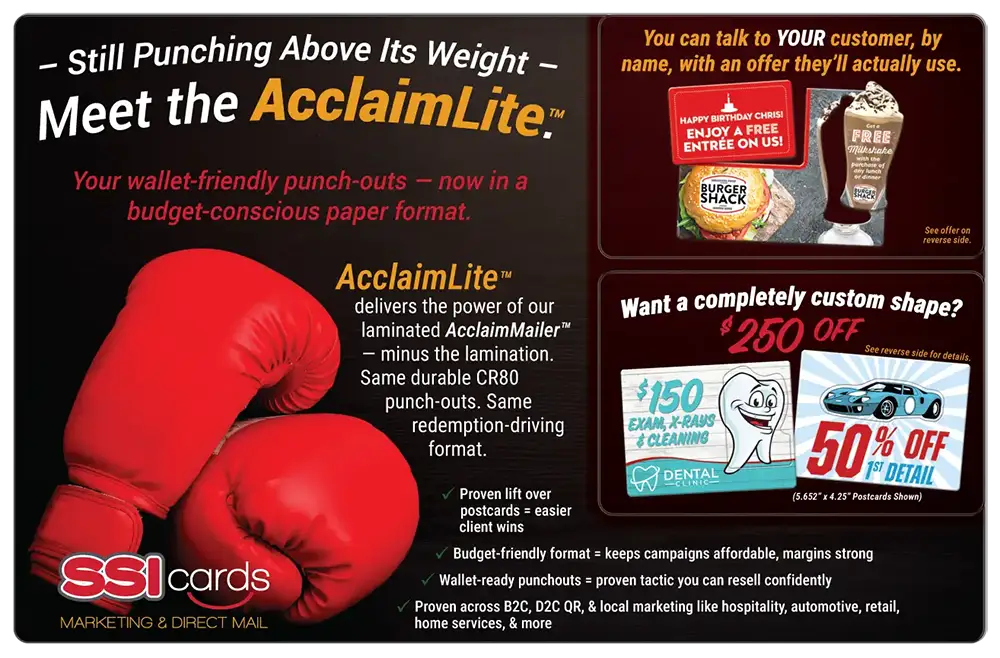
Traditional paper postcards can be a practical choice for straightforward campaigns. AcclaimLite™ offers gloss and matte paper postcards with break-off cards and no plastic.
For campaigns where offer retention is especially important, AcclaimMailer™ is a laminated postcard with wallet-friendly break-off cards designed to mimic the look and feel of a gift card. Recipients may retain these offer cards beyond the initial mailbox interaction, and custom-shaped break-offs can reinforce a relevant business or promotion.
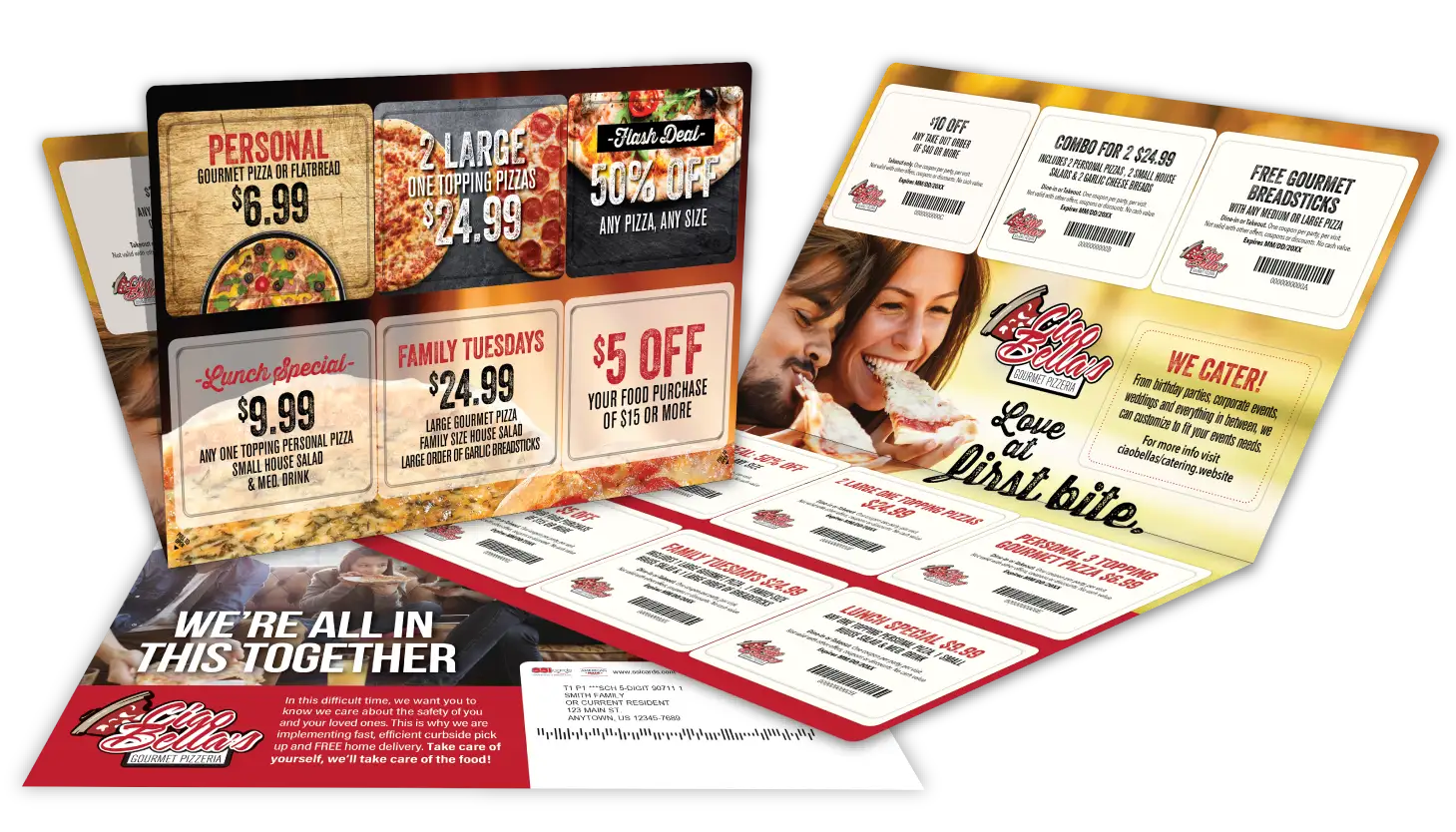
For campaigns that need to promote many services, incentives, or coupon offers in one mailing, Acclaim10™ is a laminated self-mailer with up to 10 unique, wallet-friendly offer cards.
For organizations seeking a biodegradable option without sacrificing a durable laminated format or wallet-friendly break-off offers, NVIO™ is designed to begin breaking down in landfill conditions.
Print Mistakes That Hurt a Campaign
A strong offer can lose impact when basic production details are missed. Avoid:
- Low-resolution images or pixelated logos
- Paper stock that feels too thin for the offer or brand
- Poor color contrast
- Small text that is difficult to read
- Unproofed personalized fields, URLs, offer codes, or QR codes
- Decorative finishes that interfere with the message
- No clear call to action
Before approval, check artwork, spelling, trim, folds, mailing-panel placement, personalized data, postal requirements, and response mechanisms.
Print Quality, Retention, and Response
Print quality alone does not guarantee results. A campaign still requires a relevant audience, clear offer, appropriate timing, good creative, and consistent follow-up.
Quality can contribute to whether a recipient pauses, handles, keeps, trusts, or responds to a mail piece. In documented SSI Cards customer campaigns where laminated break-off formats were tested against paper postcards using the same or comparable list, artwork, and offer, customers have reported stronger redemption and ROI with the laminated format.
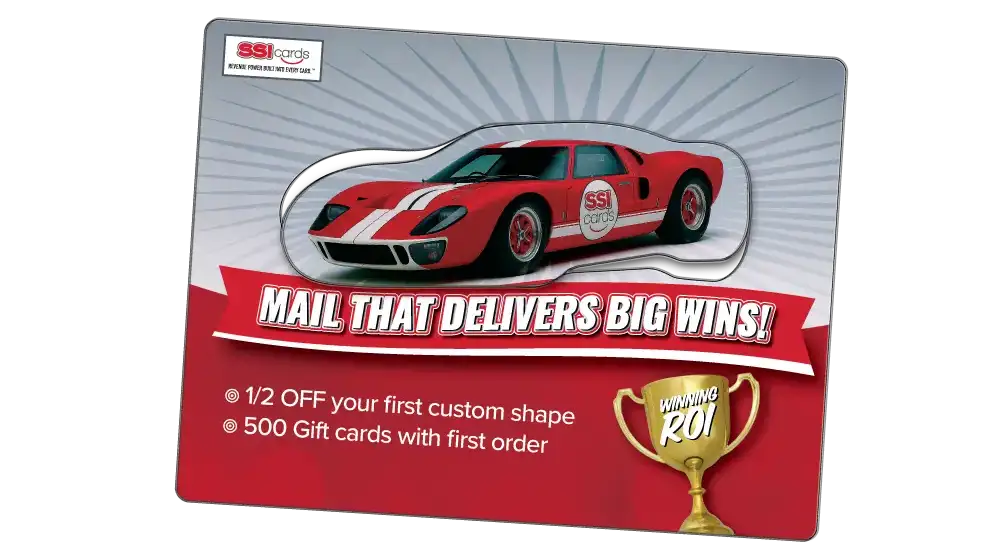
For example, a national car wash chain used a custom race-car-shaped break-off card across 40 locations. The company reported 450% ROI within four months. Results vary based on audience, offer, timing, creative, list quality, campaign execution, and follow-up.
Connect Print With Digital Measurement
Direct mail and digital marketing can work together. A tangible mail piece can capture attention, while digital tools simplify response and measurement.
Useful response mechanisms include:
- QR codes linked to campaign-specific landing pages
- Personalized URLs
- Unique offer codes
- Dedicated phone numbers with call tracking
- CRM attribution and matched-back sales
USPS Informed Delivery can add a digital component to eligible physical mail campaigns by providing consumers with digital previews of incoming mail. USPS maintains current business-mailer requirements and campaign resources through PostalPro, so current program requirements should be reviewed before planning around the service.
For businesses that want a steady mail cadence and ongoing creative testing, AcclaimFlex™ is a pay-as-you-go direct mail program that spreads campaign activity over time, helping businesses manage staffing, operational capacity, and upfront campaign costs.
Quick Checklist Before You Print
Before approving a direct mail campaign, confirm:
- The material, thickness, coating, and construction fit the brand, offer, and expected handling.
- The mailer is designed to retain its appearance and function through production, mailing, and recipient handling.
- The printing method fits the run size, personalization, turnaround, substrate, finishing, and production requirements.
- Images, logos, typography, and brand colors are production-ready and readable at final size.
- The offer, value proposition, and primary call to action are easy to find and understand.
- QR codes, URLs, phone numbers, and offer codes are accurate, functional, and tied to campaign measurement.
- Finishing, lamination, and die cuts improve durability, usability, or message clarity.
- Personalized data, variable fields, artwork, spelling, and final proofs have been checked.
- Trim, folds, perforations, mailing-panel placement, address area, postage area, and postal specifications are approved before production.
- Response can be attributed through unique codes, landing pages, call tracking, or CRM matching.
Key Takeaways
High-quality print leaves a lasting impression because it communicates credibility, care, and consistency before the recipient reads the message. Matching paper stock, printing method, color accuracy, finishing, and format to the audience and offer can make a direct mail piece more useful, memorable, and worth retaining.
For help selecting a direct mail format, personalization strategy, or print-production approach, Request a Quote from SSI Cards.
Frequently Asked Questions
What makes print feel high-quality?
Appropriate paper weight, texture, sharp reproduction, accurate color, consistent production, and purposeful finishing all contribute to perceived quality. No single characteristic determines the entire impression.
Does paper weight really matter in direct mail printing?
Yes. Paper weight affects how substantial a piece feels when handled. The ideal weight depends on the format, mailing requirements, brand, and campaign objective.
What is the difference between offset and digital printing?
Offset uses plates to transfer ink, while digital printing applies images directly to the substrate without traditional plates. Both can produce high-quality direct mail. Digital printing enables variable data, so names, offers, images, and QR codes can change from piece to piece, and modern presses can also handle substantial volumes. Many digital presses can accurately match or emulate specified Pantone and other brand colors through color management, expanded-gamut inks, and spot-color capabilities. Offset can be a strong choice for consistent artwork or specialized production needs. Choose based on the campaign’s materials, finishing, personalization, turnaround, production requirements, and total economics.
Which print finishes make direct mail feel more premium?
A durable laminated format can create a substantial, polished feel while helping a piece resist scuffs, moisture, and repeated handling. Gloss or matte lamination can also influence how color, texture, and brand presentation are perceived. Foil stamping, embossing, spot UV, and custom die cuts can add distinction when they reinforce the logo, offer, product, or response mechanism. The best finish is the one that improves the recipient’s experience and supports the campaign’s purpose rather than simply adding decoration.
How much should a small business spend on print quality?
The goal is not to maximize production spend. It is to maximize ROI. The right investment depends on the audience, offer, format, materials, mailing cost, and expected customer value. A more expensive format is worthwhile when its added cost is justified by stronger retention, response, revenue, or ROI. Test, measure, and adjust future campaigns based on actual results.
Does high-quality print improve response or brand recall?
High-quality print can strengthen a mail piece’s physical impact by making it more noticeable, credible, durable, and worth retaining. It does not guarantee a higher response rate, but it can help the piece make a stronger impression and remain useful longer.
A USPS Office of Inspector General study conducted with Temple University found that participants spent more time with physical advertisements, showed stronger emotional responses, and demonstrated better memory and recall than with digital advertisements in the study setting. Quality materials, sharp reproduction, accurate color, and durable construction can help a direct mail piece take greater advantage of that physical interaction.
What are common print mistakes that hurt credibility?
Common problems include poor image resolution, inconsistent color, paper stock that does not fit the offer or intended use, weak finishing, and printed elements that are difficult to read.
A low-quality mailer can also hurt brand perception when it lands alongside professionally produced pieces from competitors. A flimsy, flyer-like piece can make a business appear less established or credible, especially when competing messages in the same mailbox look more polished and purposeful.
Is digital printing good enough for personalized direct mail?
Yes. Modern digital printing can produce high-quality, professional direct mail while supporting variable data printing and imagery. It allows names, offers, images, locations, and other elements to change from piece to piece without requiring separate print runs for every version.
By Sean Goade
Executive VP | SSI Cards Marketing & Direct Mail
About the Author
Sean Goade is Executive VP of SSI Cards Marketing & Direct Mail. He specializes in helping businesses leverage high-impact direct mail strategies, gift cards, and loyalty solutions to drive customer engagement, retention, and growth.