
KEY POINTS
- Direct mail remains one of the highest-response local marketing channels.
- Targeting and offer quality matter more than mail volume.
- Choose the right format (postcards, letters, premium formats) for your goal.
- Track every campaign with QR codes, promo codes, PURLs, or phone numbers.
- Test, measure, and optimize to improve ROI over time.
Successful direct mail campaigns come down to three fundamentals: reaching the right audience, presenting an offer that motivates action, and using a format that keeps the offer visible long enough to drive redemption. For local businesses choosing neighborhoods, routes, and audiences, direct mail becomes a measurable marketing channel that can generate strong ROI. This guide covers what direct mail marketing is, why it continues to perform well in 2026, mailing strategies and lists, format options, costs, design principles, integration with digital tools, ROI measurement, common mistakes, and a practical checklist.
What Is Direct Mail Marketing?
Direct mail marketing sends physical promotional pieces such as postcards, letters, flyers, or self-mailers through the postal system to prospects, customers, or entire neighborhoods. The goal is to deliver a tangible message that stands out in the mailbox, encourages the recipient to take a specific action, and produces measurable results. Unlike email or social media ads that compete for attention in digital spaces, a physical piece arrives as something recipients can hold, read at their convenience, and keep for reference.
It works through a combination of geographic targeting and physical format. Businesses select recipients by address, carrier route, demographics, or past purchase behavior. The mail piece itself carries the offer, call to action, and branding directly to the household or business. When executed well, the channel delivers response rates that often exceed those of digital-only efforts for local promotions because the format creates a more deliberate and memorable interaction.
Why Direct Mail Still Works for Local Businesses
Digital fatigue reduces responsiveness to constant screen messages. Physical mail cuts through by engaging multiple senses and arriving as a deliberate item rather than another notification. For local businesses, it offers precise geographic targeting by radius or carrier route. Recipients often view tangible mail as more credible than digital ads alone, supporting community trust and loyalty.
Direct mail performs best for local businesses when paired with digital tools rather than used alone. The physical piece drives initial awareness and retention, while QR codes, PURLs, and USPS Informed Delivery add easy response paths and extra digital touchpoints.
Direct Mail Response Rates and Benchmarks
Response rates vary based on list quality, offer strength, creative execution, and format. According to the ANA Response Rate Report, house lists of existing customers typically generate 5% to 9% response or higher for strong, timely offers. Prospect lists of new or cold audiences more commonly range from 1% to 3%, though tightly targeted local lists can perform better. Every Door Direct Mail saturation campaigns often see 0.5% to 2% response, with results improving when the offer has broad local appeal such as restaurant promotions or home service specials.
These figures are ranges, not guarantees. A compelling offer with a clear deadline and quality production lifts results. However, basic paper postcards and EDDM typically produce significantly lower response and ROI when the primary goal is measurable redemptions rather than broad awareness. High-retention formats with wallet-retained pop-outs routinely deliver 2-5x higher redemption rates on the same lists and offers because the piece stays visible and functional long after arrival.
SSICards.com has decades of experience printing and mailing every major format of direct mail postcards. Laminated pop-out formats have consistently delivered higher redemption rates and stronger ROI than basic paper postcards or EDDM on comparable campaigns. While per-piece costs are modestly higher, the improved response often produces better overall results for the same budget when measurable redemptions are the objective. Real results from wallet-friendly break-off postcard campaigns include:
- Regional grocer: sustained 25% average redemption rate over 5 years on targeted retention mailings (original goal was 10%), including outreach to previously lapsed shoppers.
- National car wash chain: 450% ROI in the first 4 months across 40 locations, rising above 700% within 10 months, aided by custom-shaped pop-outs.
- Restaurant and bar groups: 32.7% redemption on the first campaign, rising to 45% on follow-up drops.
- Texas Mexican restaurant chain: 18% redemption with more than 600% ROI.
- Men’s clothing retailers: consistent 8–12% yearly redemption rates year after year.
Types of Direct Mail Formats for Local Businesses
Local businesses select direct mail formats such as postcards, letters, flyers, and self-mailers based on message, audience, and budget. They also choose a mailing strategy, such as targeted lists, carrier route saturation, or EDDM, based on campaign goals.
Postcards
Not all postcards are equal but as a whole, direct mail postcards work well for quick offers, coupons, grand openings, and simple promotions because recipients can absorb the message in seconds. They qualify for favorable postage rates at standard sizes. As shown in the performance data above, format and production quality often have more impact on results than exact size or basic vs. premium paper stock. High-retention formats with wallet-friendly break-off cards tend to drive stronger engagement because the offer remains visible and readily available after delivery.
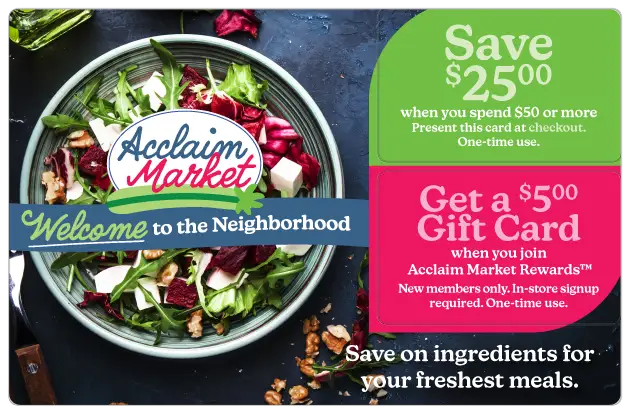
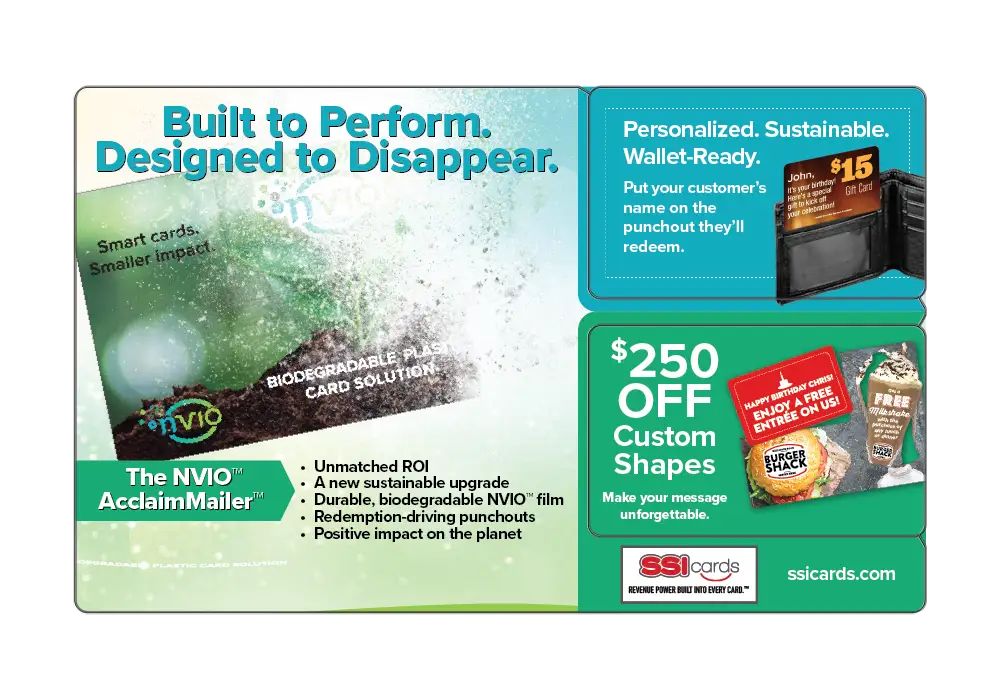
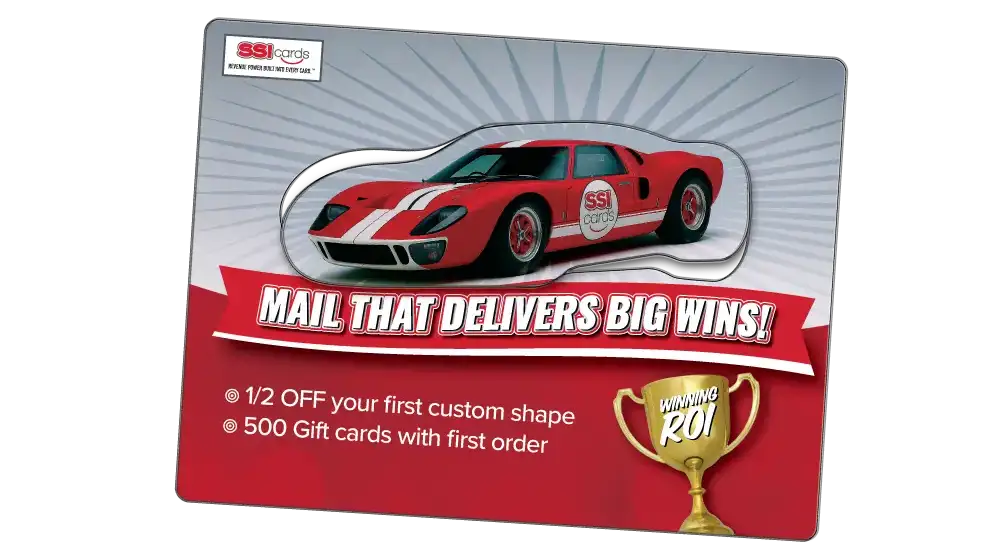
High-retention postcard formats add durability, visual impact, and interactive elements that increase perceived value and retention. The AcclaimMailer™ combines laminated postcards with durable pop-out cards designed to resemble gift cards. These pieces arrive looking professional and stand out in a stack of mail. Recipients tend to keep the pop-out elements in their wallet or on a keychain, creating repeated brand exposure and higher redemption rates compared with standard paper postcards that are often discarded quickly.
Businesses that prefer traditional paper can choose the AcclaimLite™ gloss or matte paper postcards for a cost-effective yet professional option. For environmentally conscious campaigns, the NVIO™ biodegradable plastic postcards provide a durable alternative that meets eco goals without sacrificing the engagement benefits of a laminated, high-retention break-off format.
Postcard formats with wallet-friendly break-off cards consistently generate higher redemption rates and ROI than standard paper postcards because recipients are far more likely to keep the offer. Since postage is usually the largest campaign expense, mailing fewer high-retention pieces often produces more sales at a lower cost per redemption.
Letters and Sales Letters
Letters suit warmer audiences or offers needing more explanation and personalization. They convey higher perceived value and provide space for detailed messaging or testimonials. Warm leads, loyalty communications, and reactivation campaigns can benefit. Personalization improves response, though letters cost more to produce and mail than postcards and generally get a 1-2% response rate.
Every Door Direct Mail (EDDM) and Saturation Mail
Every Door Direct Mail (EDDM) reaches every address on selected carrier routes without a mailing list. Note that while all EDDM is saturation mail, not all saturation mail is EDDM. It suits new businesses, grand openings, or broad local offers like restaurant specials. Postage rates change periodically, so businesses should verify current USPS pricing when budgeting campaigns, such as USPS Notice 123, with a retail option requiring no permit for smaller volumes. Response rates are typically lower than targeted campaigns, but low cost and simplicity make it attractive for neighborhood saturation or testing.
EDDM vs Saturation Which to Use
Saturation mailing works exceptionally well when data is used to target specific, high-performing neighborhoods. EDDM, by contrast, forces you to blindly blanket an entire carrier route. Because a single route frequently mixes widely different demographics (e.g., apartments + single‑family homes), EDDM can dilute your ROI by delivering to households unlikely to redeem your specific offer or that yield low-value redemptions. Businesses choose between the two based on whether list-free simplicity or targeted managed capabilities better fit the campaign. Choose EDDM for low‑cost, list‑free reach; choose targeted saturation when you can afford list selection and want higher redemption efficiency.
Flyers, Menus, and Self-Mailers
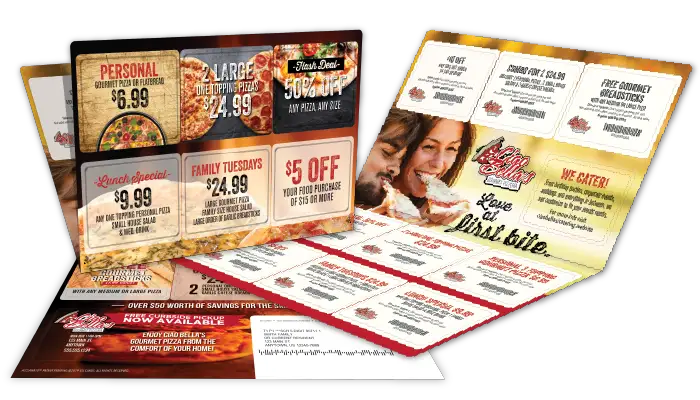
Flyers and menus suit restaurants, service businesses, and retail locations that need to convey more information or multiple options in one piece. Self-mailers eliminate the envelope for cost and production savings while still allowing larger formats or folded designs. For campaigns that want to present multiple distinct offers in a single mailing, the Acclaim10™ provides a high-redemption alternative to traditional coupon packs. It uses laminated construction and wallet-friendly pop-outs while accommodating up to ten unique offers, preserving the engagement and durability advantages of premium formats.
These formats work best when the additional content justifies the extra production cost and when the design remains clean and focused. Overloading a piece with too many messages can dilute the primary call to action. Local businesses in food service, home improvement, and retail frequently use these options for seasonal promotions, new menu items, or multi-location offers.
How Much Does Direct Mail Marketing Cost?
Direct mail costs vary by format, quantity, list or routes, design, printing, and postage. Postage is usually the largest expense. USPS rates rise 3% to 5% in mid-July 2026 (USPS Notice 123), with retail postcard postage moving to 65¢ and EDDM to about 26¢ per piece. Factor the adjustment into budgets for campaigns near that date.
Typical Costs by Format
All-in per-piece costs, including design, list or route prep, printing, and postage, generally fall into these illustrative ranges for 2026 campaigns. Actual pricing depends on volume, specifications, and vendor.
- EDDM or saturation mail: $0.30 to $0.55 per piece. Lowest cost option for broad awareness, but response rates and ROI can be far lower when measurable redemptions are the goal.
- Standard paper postcards: $0.40 to $1.00+ per piece. Good balance of cost and visibility for simple offers; varies with quantity and finishing.
- High-retention break-off card or plastic formats: $0.50 to $2.00+ per piece depending on customization and volume. Higher upfront cost but often lower cost per redemption because response rates and retention are significantly higher.
- Letters in envelopes: $0.38 to $1.50+ per piece. Low end ($0.38 to $0.55) utilizes automated carrier route saturation postage, basic layout design, and high-speed automated folding/inserting for broad geographic targets. High-end ($1.50+) versions account for filtered, non-saturated lists requiring higher 5-digit automation postal rates, specialty envelope stocks to help increase open rates, variable data matching, and segmented copy.
For campaigns where response and redemptions drive ROI, basic paper postcards and EDDM are often entry-level choices. Their low per-piece cost is offset by much lower response rates, so businesses often spend more overall for weaker results. High-retention break-off formats that generate higher redemptions per piece deliver better ROI even at higher per-piece cost because postage is the dominant expense. Mailing fewer high-performing pieces frequently costs less while producing far stronger returns.
Budgeting a Direct Mail Campaign as a Local Business
Most local businesses start with a test budget rather than committing to a large drop. A practical first campaign often ranges from $1,000 to $5,000, covering 1,000 to 5,000 pieces depending on format and list or route choices. This size allows meaningful data collection while limiting risk.
Key budget components include creative design, list rental or route selection, printing and finishing, postage, tracking setup such as QR codes or personalized URLs, and any agency or mail house coordination fees.
Planning for follow-up mailings improves results. A single drop rarely maximizes potential; a sequence of two or three coordinated pieces to the same audience typically lifts overall response.
Budget accordingly and build in time for list cleaning, design approval, and production. Many vendors offer volume discounts or bundled services that can improve economics for ongoing programs.
Building and Targeting Your Mailing List
The mailing list strongly influences success. Local businesses use house lists of existing customers (highest response), purchased prospect lists targeted by radius or demographics, EDDM, or saturation mail that requires no list and reaches every address on selected routes.
House lists typically outperform prospect lists by two to five times because recipients know the business. Clean, segmented customer data enables precise targeting of lapsed buyers or high-value patrons. Purchased lists support geographic and demographic targeting for new audiences.
EDDM eliminates list costs and works well for broad local awareness, though response rates are usually lower due to lack of segmentation. Route selection should match the trade area. Birthday direct mail adds timely personalization that often boosts response. Clean data and suppression of recent responders protect results regardless of list type.
Manufacturer / B2B note: For manufacturers and B2B mailings, emphasize account lists, distributor routes, and trade area targeting rather than consumer storefront details. Focus on ship-to accounts, purchasing contacts, and distributor territories when selecting lists and routes.
Designing a Direct Mail Piece That Gets a Response
Effective design starts with a clear offer and single primary call to action. Recipients should understand in seconds what they gain and what to do next, whether visiting, calling, scanning, or redeeming by a deadline. Urgency from limited time or availability prompts action. Consistent branding and professional quality signal credibility; cheap-looking pieces get ignored.
For postcards, clean layouts with readable hierarchy help the headline, offer, and CTA stand out. High-retention break-off formats, particularly of the laminated variety, increase perceived value and encourage recipients to keep the piece. Gift cards can serve a similar role by giving customers a tangible reason to return, spend more, or share the business with someone else. Local businesses that use gift cards regularly can also order wholesale gift cards in bulk to support seasonal promotions, loyalty programs, and ongoing in-store sales. Variable data enables personalization. Every element should support the main goal; clutter dilutes focus. Test creative on small segments before scaling.
Integrating Direct Mail with Digital Marketing
Direct mail and digital produce the strongest results when used together. The physical piece often outperforms digital-only efforts in visibility and retention for local promotions, while QR codes, PURLs, and USPS Informed Delivery make response easier to track and add digital touchpoints. QR codes link to trackable landing pages for immediate action and attribution. PURLs enable individual engagement tracking and follow-up.
USPS Informed Delivery provides digital previews of the mail piece via email or app before arrival, plus opportunities for interactive content or CTAs in the preview. This adds awareness touchpoints at low cost and increases the chance recipients notice and act.
Retargeting digital ads to mailed households can further amplify frequency, particularly with traditional paper postcards that might otherwise be lost. When digital supports rather than replaces the physical piece, the message becomes harder to ignore and easier to respond to.
How to Measure Direct Mail ROI
Accurate ROI measurement requires built-in tracking from the start. Common methods include unique promo codes or coupon numbers printed on each piece, dedicated phone numbers or extensions that route to specific campaigns, personalized landing pages or PURLs, and QR codes that direct to trackable destinations. For broader analysis, matchback studies compare purchase behavior between mailed households and a control group of similar non-mailed households, isolating the incremental lift attributable to the campaign.
USPS tracking services and Informed Delivery campaign data provide additional visibility into delivery and engagement. Once responses and attributed revenue are captured, ROI is calculated as total attributed revenue minus total campaign costs, divided by total costs, expressed as a percentage or multiple. High-retention formats frequently show higher ROI because the elevated response and retention rates more than offset any higher per-piece production cost. Businesses that track rigorously and compare formats, offers, and list segments gain the insights needed to optimize future campaigns and justify continued investment.
Common Direct Mail Mistakes Local Businesses Make
Several recurring issues reduce results or waste budget.
- No clear offer or single CTA. Vague messaging or competing calls to action confuse recipients. Every piece needs one primary action with a clear benefit and deadline.
- Single mailing instead of a sequence. One drop rarely maximizes results. A planned series of two or three coordinated pieces to the same audience typically generates higher cumulative response.
- Skipping tracking. Without unique codes, PURLs, or matchback analysis it is impossible to measure what worked or calculate true ROI. Build tracking in from the start.
- List too broad or too narrow. Broad targeting wastes budget on poor fits. Overly narrow lists miss opportunities. Balance relevance with volume and always clean data.
- Choosing basic paper postcards or EDDM when response is the goal. Choose the format that matches your objective. When measurable redemptions are the goal, high-retention formats generally perform better. For broad awareness, basic paper postcards and EDDM can be effective.
Getting Started: A Direct Mail Checklist for Local Businesses
Use this checklist to move from idea to execution.
- Define the goal and craft a strong offer with deadline and single CTA.
- Choose the direct mail format and targeting strategy that best fits your goals.
- Select or build the list or EDDM routes and clean the data.
- Set a test budget and timeline including creative, production, mailing, and follow-up.
- Build in tracking: unique codes, QR codes, PURLs, or Informed Delivery.
- Design for clarity and professionalism; proof all elements before production.
- Partner with an experienced provider and request a quote to explore options and timelines.
Key Takeaways
Direct mail marketing produces the strongest results for local businesses when it combines precise targeting, a clear and trackable offer, and a format suited to the goal. Basic approaches like standard paper postcards or EDDM can work well for broad awareness and simple offers, but they generally deliver lower response and ROI on campaigns where measurable redemptions are the priority. High-retention break-off postcard formats have shown consistently higher redemption rates in real campaigns because they increase visibility and ongoing engagement. Businesses that match format to objective, test on a modest scale, track results, and follow up tend to see the best returns.
Success comes from thoughtful execution rather than volume. The channel rewards businesses that treat direct mail as a strategic part of their local marketing mix.
Ready to apply these principles? Request a quote to discuss goals and explore options, including the AcclaimMailer™ and related programs, or learn about current promotions.
Frequently Asked Questions
Is direct mail still effective for local businesses?
Yes. Direct mail remains effective when campaigns combine accurate targeting, a strong offer, quality design, the right format, and response tracking. The best results come from matching the mailing strategy and format to the campaign goal, whether that is customer acquisition, retention, or repeat visits.
How much does a direct mail campaign cost?
Costs vary based on format, quantity, list strategy, printing, and postage. Most local businesses start with test campaigns ranging from about $1,000 to $5,000 to measure results before scaling.
How many pieces should a local business mail?
The ideal quantity depends on the audience, budget, and goals. Many businesses start with 1,000 to 5,000 targeted pieces to gather meaningful response data while controlling costs.
Is EDDM better than a targeted mailing list?
EDDM works well for broad neighborhood awareness, grand openings, and low-cost saturation campaigns. However, targeted mailing lists typically deliver stronger ROI when the goal is measurable responses, redemptions, and sales.
How do you measure direct mail ROI?
Businesses can track results using unique promo codes, QR codes, PURLs, dedicated phone numbers, and tracking links. Comparing customer responses and sales before and after a campaign helps determine what worked and improve future mailings.
What type of direct mail format works best?
For businesses looking to generate the most local business per dollar spent (ROI), direct mail formats with wallet-friendly break-off cards are best for achieving those goals. These formats keep offers visible and readily available in the customer’s wallet after delivery, increasing redemption rates and ROI. The key is matching the format (laminated, biodegradable, paper, or custom-designed break-off wallet cards) and offer to the right audience through proper targeting. Common formats include postcards with two wallet break-off offers and self-mailers like Acclaim10™ with up to 10 wallet-friendly offers.
Sources & Citations
USPS Notice 123, July 2026 postage rate adjustment for First-Class Mail, postcards, and Every Door Direct Mail.
ANA (Association of National Advertisers) Response Rate Report. Latest direct mail benchmark data for house lists, prospect lists, and saturation mail.
USPS EDDM – Every Door Direct Mail
By Sean Goade
Executive VP | SSI Cards Marketing & Direct Mail
About the Author
Sean Goade is Executive VP of SSI Cards Marketing & Direct Mail. He specializes in helping businesses leverage high-impact direct mail strategies, gift cards, and loyalty solutions to drive customer engagement, retention, and growth.