
Key Points
- A high-converting direct mail piece starts with the right audience and a clear, relevant offer.
- Headlines, focused copy, and readable design help recipients quickly understand the value.
- The format should match the offer, audience, budget, and desired response, whether that means a postcard, letter, or self-mailer.
- Wallet-friendly break-off card formats can help recipients keep an offer accessible after delivery.
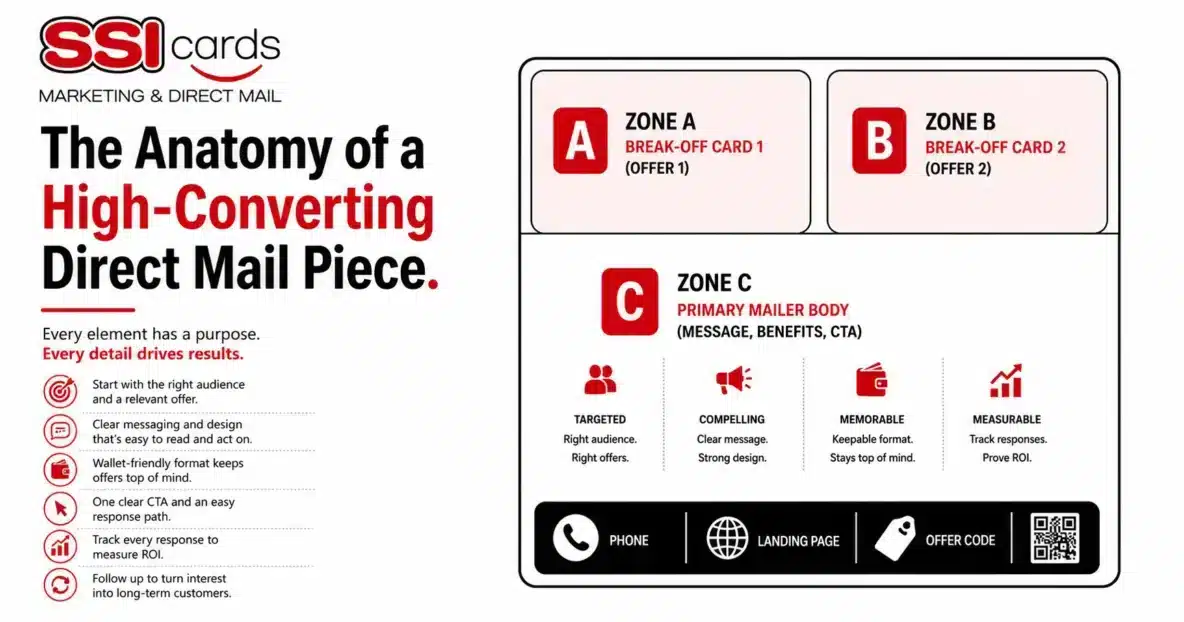
- One clear call to action and an easy response path, such as a QR code, phone number, landing page, or offer code, reduce friction.
- Tracking methods should be established before mailing so the business can measure calls, scans, redemptions, appointments, sales, and ROI.
- Direct mail is most effective when it is targeted, measurable, and supported by appropriate follow-up.
A high-converting direct mail piece combines a relevant audience, a clear offer, attention-getting copy, effective design, an obvious call to action, and a reliable way to measure response. No single element guarantees results. The offer, audience, format, timing, personalization, and follow-up all contribute to performance.
For businesses planning a direct mail campaign, the goal is not simply to create something attractive. It is to create a mail piece that gets noticed, communicates value quickly, and makes responding easy.
What Makes a Direct Mail Piece High-Converting?
A high-converting direct mail piece prompts the recipient to take the intended action, but that outcome rarely comes from just design and a clever headline by themselves. The offer, the audience, and effortless redemption matter most.
A strong mail piece usually does six things well:
- Reaches an appropriate audience
- Presents a clear and relevant offer
- Earns attention through high-impact format, headline, and design
- Communicates the benefit without unnecessary copy
- Gives the recipient one obvious next step
- Makes the response measurable
Response rate is the percentage of recipients who take the action defined as a response. That may be a purchase, redemption, phone call, appointment, QR-code scan, website visit, or form submission.
There is no universal “good” direct mail response rate. Results depend on the format, whether the mailing reaches existing customers or prospects, the offer, audience quality, creative, timing, and how the response is measured. The ANA Performance and Cost Metrics Across Direct Media report provides useful benchmarks, but its results are not guarantees for an individual campaign. Of note in ANA’s report, “Direct mail sent to house lists produced the top ROI of all media in the study at 161 percent.” Ultimately, bottom-line ROI matters far more than low cost per piece or raw impression volume.
The Offer Comes First
The offer gives the recipient a reason to act. Strong design can earn attention, but attention alone does not create a conversion.
Common direct mail offers include:
- Dollar or percentage discounts
- Buy-one-get-one (BOGO) promotions
- Free trials or consultations
- Bundled or seasonal offers
- New-customer, loyalty, or reactivation incentives
The right offer depends on the business and its economics. A discount that works for a restaurant may not make sense for a high-value service business.
Make the Offer Easy to Understand
Recipients should grasp the basic offer within seconds.
Compare:
$20 OFF YOUR NEXT $50 PURCHASE
With:
Discover a New Way to Save on Your Next Shopping Experience
The first example tells the recipient exactly what they receive. The second requires more interpretation.
State important conditions clearly, including minimum purchases, appointment requirements, expiration dates, or eligible products. The fine print should clarify the offer, not bury it.
Create Credible Urgency
Credible deadlines, limited availability, seasonal relevance, and timely service needs can encourage action. A deadline connected to a real operational window usually feels more legitimate than an artificial countdown.
The goal is not pressure. It is to give recipients a reasonable reason to act now.
Headlines, Copy, and Design
The headline must earn enough attention for the body copy to do its job. Most recipients scan rather than read every word. If the headline does not signal relevance or value, the rest of the piece may be overlooked.
Effective headlines often:
- Lead with the primary benefit
- Use a specific dollar amount or percentage when appropriate
- Address a recognizable customer problem
- Include a relevant timeframe
- Ask a question that reflects the recipient’s needs
- Incorporate variable data printing (VDP) personalization
For example:
[Recipient’s first name], is Your AC Ready for Another [City/State] Summer?
That variable data printing (VDP) personalized headline connects a local HVAC offer to a recognizable need.
Keep body copy focused on the recipient. Every sentence should support the offer, explain why the recipient should care, or move the reader toward the next step. Short paragraphs, subheads, bullets, and adequate spacing make the mail piece easier to scan.
Choosing the Right Format
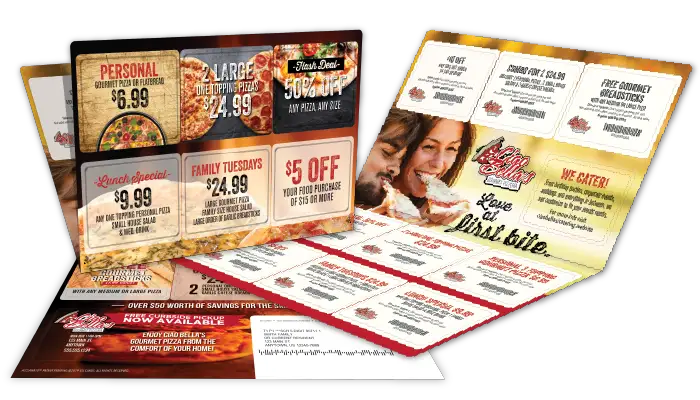
Postcards, letters, and self-mailers serve different purposes. The right choice depends on the audience, offer complexity, budget, mailing requirements, and desired response action.
- Postcards can work well for focused offers because the message is visible immediately.
- Letters can be appropriate when an offer needs more explanation, a personal tone, or privacy.
- Self-mailers can provide more room for details, images, menus, or a more expansive presentation of multiple offers.
The U.S. Small Business Administration’s direct mail guidance similarly notes that a postcard can suit an immediate offer, while a letter or multi-panel mailer can make more sense when customers need additional information.
For local businesses, direct mail can target neighborhoods and carrier routes, not just broad ZIP codes. USPS direct mail tools support geographic planning for local campaigns. For Every Door Direct Mail campaigns, postal requirements should be considered before artwork is approved. USPS EDDM Retail standards cover applicable size, thickness, weight, addressing, and preparation requirements. Every Door Direct Mail can be useful for neighborhood-focused promotions, including new locations, seasonal services, and local events.
Wallet-Friendly Break-Off Formats
AcclaimMailer™ is a high-impact laminated postcard, engineered to remain clean and professional through the mail stream, equipped with wallet-friendly break-off cards that keep offers accessible.
NVIO™ provides a biodegradable plastic option with the same wallet-friendly break-off function.
AcclaimLite™ provides a paper, no-plastic postcard format with wallet-friendly break-off cards.
For campaigns requiring up to 10 distinct wallet-friendly break-off offers in one laminated self-mailer, Acclaim10™ is a high-impact self-mailer that accommodates up to 10 unique wallet-friendly break-off offers.
In documented SSI Cards campaigns, laminated break-off formats, particularly AcclaimMailer™, have generated higher response rates and ROI than conventional paper postcards when customers tested comparable lists, offers, and creative. The durable lamination protects the postcard while mimicking the look and feel of a heavy 30 mil plastic gift card. This conveys an immediate sense of intrinsic value, while the wallet-sized break-off cards give recipients a convenient way to retain the offer long after delivery.
For campaigns centered specifically on gift card sales, businesses can also incorporate gift cards into direct mail promotions to create a tangible offer recipients can purchase, redeem, or give to someone else. Gift card mailers can be especially effective for seasonal promotions, customer rewards, and campaigns designed to encourage future visits.
Custom Shapes Can Increase Engagement
Wallet-friendly break-off cards can be customized into shapes that reinforce an offer, product, or brand, such as a logo or themed design. A distinctive shape can make a physical mail piece more visually distinctive and give recipients another reason to keep an offer accessible after delivery. USPS-supported research with Temple University found that physical advertisements produced stronger engagement, emotional intensity, and long-term memory encoding than digital advertisements in the study context. Learn more about why direct mail can be more memorable.
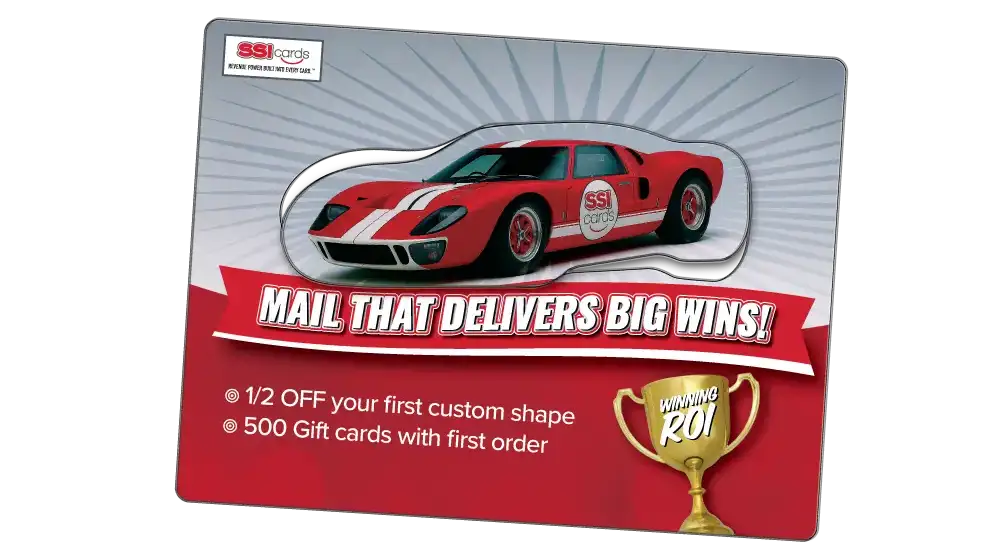
For example, a car wash chain used an AcclaimMailer™ with a custom race-car-shaped break-off card across 40 locations. Measured through in-person redemptions and QR-code responses, this campaign generated 450% ROI in four months. The custom shape reinforced the automotive theme while creating a more distinctive and memorable wallet-friendly offer. Read the SSI Cards case study. Results vary based on audience, offer, timing, creative, list quality, campaign execution, and follow-up.
Personalization and List Quality
A well-designed mailer cannot compensate for an irrelevant audience. A smaller, better-qualified audience can be more valuable than a larger generic list.
Variable data printing allows names, offers, codes, images, and other elements to change from piece to piece. Personalization works best when it adds relevance, not when it simply inserts a recipient’s name.
Useful segmentation inputs include:
- Purchase history
- Geographic location
- Previous response
- Loyalty status
- Customer value
- Product interest
For example, a restaurant might send one offer to nearby prospects and a different offer to customers who have not visited recently. The objective is relevance, not personalization for its own sake.
List hygiene also matters. Outdated addresses and poor demographic matches waste printing and postage.
Make the Next Step Easy
Once the recipient is interested, the next step should be obvious. One primary call to action reduces confusion, although a campaign can offer more than one convenient response path.
Common response options include:
- Calling the business
- Scanning a QR code
- Visiting a dedicated landing page
- Using a personalized URL
- Scheduling an appointment
- Redeeming an in-store offer
If a mailer promotes a specific offer, the landing page should take the recipient directly to that offer rather than forcing them to search through a general website.
Track What Converts
Measurement turns a mailing into a learning system. Establish the tracking method before the campaign begins.
Useful tracking methods include:
- Unique offer codes
- QR codes
- Dedicated phone numbers
- Campaign-specific landing pages
- CRM attribution
- Point-of-sale redemption data
- Matched-back sales analysis
If the goal is appointments, track appointments. If the goal is store visits, track redemptions or purchases. If the goal is revenue, connect responses to sales whenever practical.
Direct mail can also work alongside digital marketing. The Chief Marketer 2026 Direct Mail Benchmark Report supports viewing direct mail as part of a measurable campaign, often with digital follow-up rather than as a stand-alone tactic. USPS Informed Delivery can add a synchronized digital touchpoint before a mailpiece arrives for eligible recipients.
Common Mistakes That Lower Response
Several recurring problems reduce results:
- Cluttered layouts or unclear offers
- Headlines that do not communicate a benefit
- Buried or confusing calls to action
- Poor list quality or outdated data
- Too much copy that dilutes the message
- A complicated response process
- No tracking method
- No follow-up plan
Addressing these problems before printing is less expensive than diagnosing them after the campaign.
Another mistake is focusing only on the lowest production cost.
For example, consider two choices under the same budget:
- Option A: 10,000 standard paper postcards yielding an estimated 5% response rate (500 responses)
- Option B: 7,500 laminated postcards yielding an estimated 7% response rate (525 responses)
Choosing Option A simply to mail more pieces generates fewer total redemptions and a lower overall return. These figures are illustrative. Actual costs, response rates, and ROI vary by audience, offer, format, postage, creative, and campaign execution.
Printing and format are only part of campaign economics. Because postage represents a significant fixed portion of per-piece costs, investing in a higher-performing format is often more cost-effective when higher response rates drive greater net revenue.
A Quick Checklist Before You Print
Before approving a direct mail piece, ask:
- Is the audience clearly defined and the list accurate?
- Is the offer understandable within a few seconds?
- Does the headline communicate a relevant benefit?
- Does the format fit the campaign objective and budget?
- Is the design easy to scan and read?
- Does personalization add useful relevance?
- Is there one clear, low-friction call to action?
- Can the campaign’s responses and sales be attributed?
- Does the piece meet applicable postal requirements?
- Is there a follow-up plan?
If several answers are no, redesigning the mail piece may not solve the underlying problem. The campaign strategy may need to be reconsidered first.
Key Takeaways
A high-converting direct mail piece is the result of coordinated decisions. The offer, audience, copy, format, design, personalization, call to action, and measurement strategy should all support the same desired action.
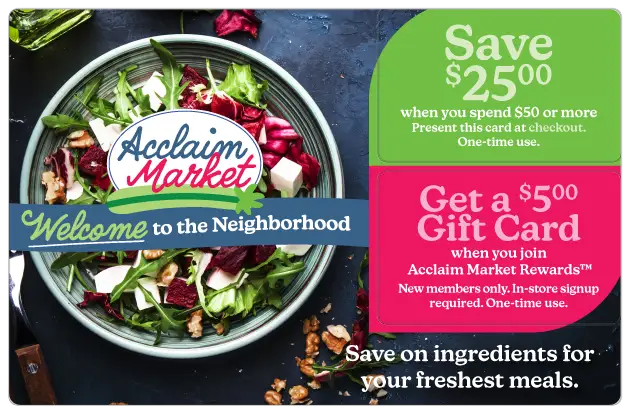
In documented SSI Cards campaigns, a southwest regional grocer achieved a 25% average redemption rate over five years in loyalty-retention mailings targeting selected audiences, including declining and previously inactive shoppers. Results vary based on audience, offer, timing, creative, list quality, campaign execution, and follow-up.
For a steady, flexible approach, AcclaimFlex™ offers a pay-as-you-go postcard subscription. Businesses can also request a quote to discuss a specific campaign.
Frequently Asked Questions
What makes a direct mail piece successful?
A successful direct mail piece combines a relevant audience, clear offer, readable design, focused copy, simple call to action, and measurable response method. The combination matters more than any one feature.
What is a good response rate for direct mail?
There is no universal good response rate. Results vary by format, by list type, offer, industry, timing, and how response is defined. Published benchmarks provide direction, not guarantees for an individual campaign.
What should be included in a direct mail piece?
Include a clear offer, benefit-led headline, focused supporting copy, recognizable branding, an obvious call to action, important terms, and a tracking method whenever practical.
Does personalization improve direct mail results?
Yes. Addressing a recipient by name instead of a generic label such as ‘Resident’ can make a mail piece feel more personal and increase the likelihood it is noticed or read. Personalization becomes even more powerful when combined with relevant audience segmentation and tailored offers that speak directly to the recipient’s needs.
What format works best for direct mail?
No single format is best for every campaign. Standard postcards provide immediate visibility, letters support detailed messaging and privacy, and self-mailers provide additional room for complex information. SSI Cards’ postcard formats can also support multiple offers through wallet-friendly break-off cards, while Acclaim10™ is specifically designed as a laminated self-mailer with up to 10 distinct break-off offers. Match the format to the audience, offer complexity, budget, and desired response.
How do you track a direct mail campaign?
Use unique offer codes, QR codes, dedicated phone numbers, campaign-specific landing pages, CRM attribution, redemption data, or matched-back sales. Define the response metric before mailing.
Why do direct mail pieces fail?
Common causes include weak offers, poor targeting, outdated data, cluttered design, unclear calls to action, complicated response paths, weak format, and no follow-up plan.
Is direct mail still effective compared with digital marketing?
Yes. Direct mail remains effective when it is targeted, measurable, and coordinated with digital follow-up. ANA’s 2023 report found that direct mail to house lists produced the highest reported ROI among the media and list combinations studied, at 161%. Physical mail creates a tangible interaction, while QR codes, personalized URLs, and dedicated landing pages make responses easier to track.
By Sean Goade
Executive VP | SSI Cards Marketing & Direct Mail
About the Author
Sean Goade is Executive VP of SSI Cards Marketing & Direct Mail. He specializes in helping businesses leverage high-impact direct mail strategies, gift cards, and loyalty solutions to drive customer engagement, retention, and growth.