
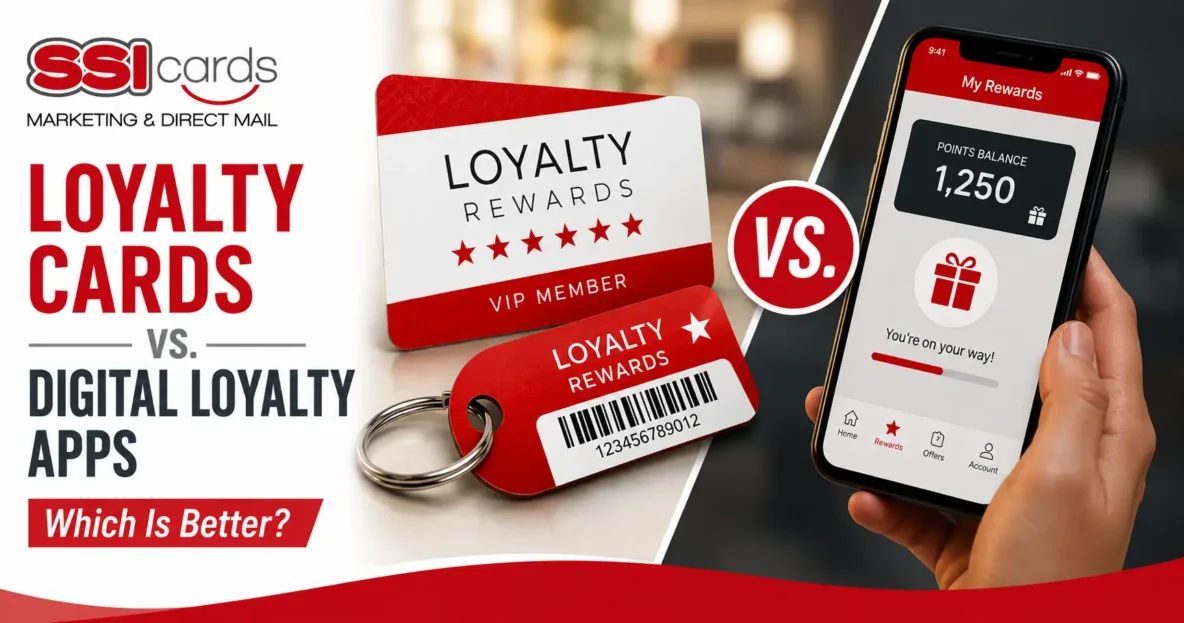
Loyalty cards, key tags, and digital loyalty tools can all help encourage repeat business. The better choice is the one that customers will actually use and the business can operate consistently.
Physical loyalty cards and key tags offer a simple, visible way to identify members and access rewards while also working with compatible loyalty, POS, and CRM systems. Digital loyalty apps can add customer data, personalization, automation, and mobile access. The right choice depends on customer habits, program complexity, staff capacity, technology, budget, and marketing goals.
Key Points
- Physical loyalty cards and key tags provide familiar, visible access to rewards and member identification.
- Digital loyalty apps can support richer data and automated communications, but they require adoption, setup, and ongoing management.
- A simple reward that is easy to earn and redeem matters more than the format alone.
- Physical cards can include barcodes, QR codes, magnetic stripes, and variable data for compatible loyalty, POS, and CRM systems.
- A hybrid approach can give customers a physical option while supporting digital enrollment, accounts, or communications.
What Is the Difference Between Loyalty Cards and Digital Loyalty Apps?
A physical loyalty card may be a paper punch card, a wallet card, a plastic card, or a key tag. The customer presents it at checkout to receive a punch, scan a barcode or QR code, swipe a magnetic stripe, or identify a loyalty account.
A digital loyalty program may use a dedicated mobile app, QR-code enrollment, or a loyalty pass stored in Apple Wallet or Google Wallet. Unlike a gift card, a loyalty pass typically identifies the customer and displays points, rewards, or membership benefits.
Loyalty cards and digital loyalty apps both reward repeat visits, but they differ not only in how customers participate but also in how businesses track and use program data.
How Each Works at Checkout
Physical Cards and Key Tags
A paper punch card is the simplest version. For example, a coffee shop can give one punch per qualifying purchase and offer a reward after a specified number of visits. It is easy to explain, but it gives the business limited customer-level data unless it is tied to another system.
A durable loyalty card or key tag can support more than a manual punch. Barcodes, QR codes, magnetic stripes, and variable member numbers can connect the physical item to a compatible POS, CRM, or loyalty platform. Matching key tags provide fast access at the counter.
SSI Cards manufactures custom loyalty cards, key tags, and combo cards for physical loyalty, membership, and rewards programs. Loyalty cards and key tags can also be custom die-cut into shapes that reinforce a business’s brand, product, or promotion, giving businesses another way to make their physical loyalty program distinctive and memorable. A restaurant may use a simple reward card, an independent grocer may use a personalized card linked to an existing system, and a service business may use a key tag for quick member identification.
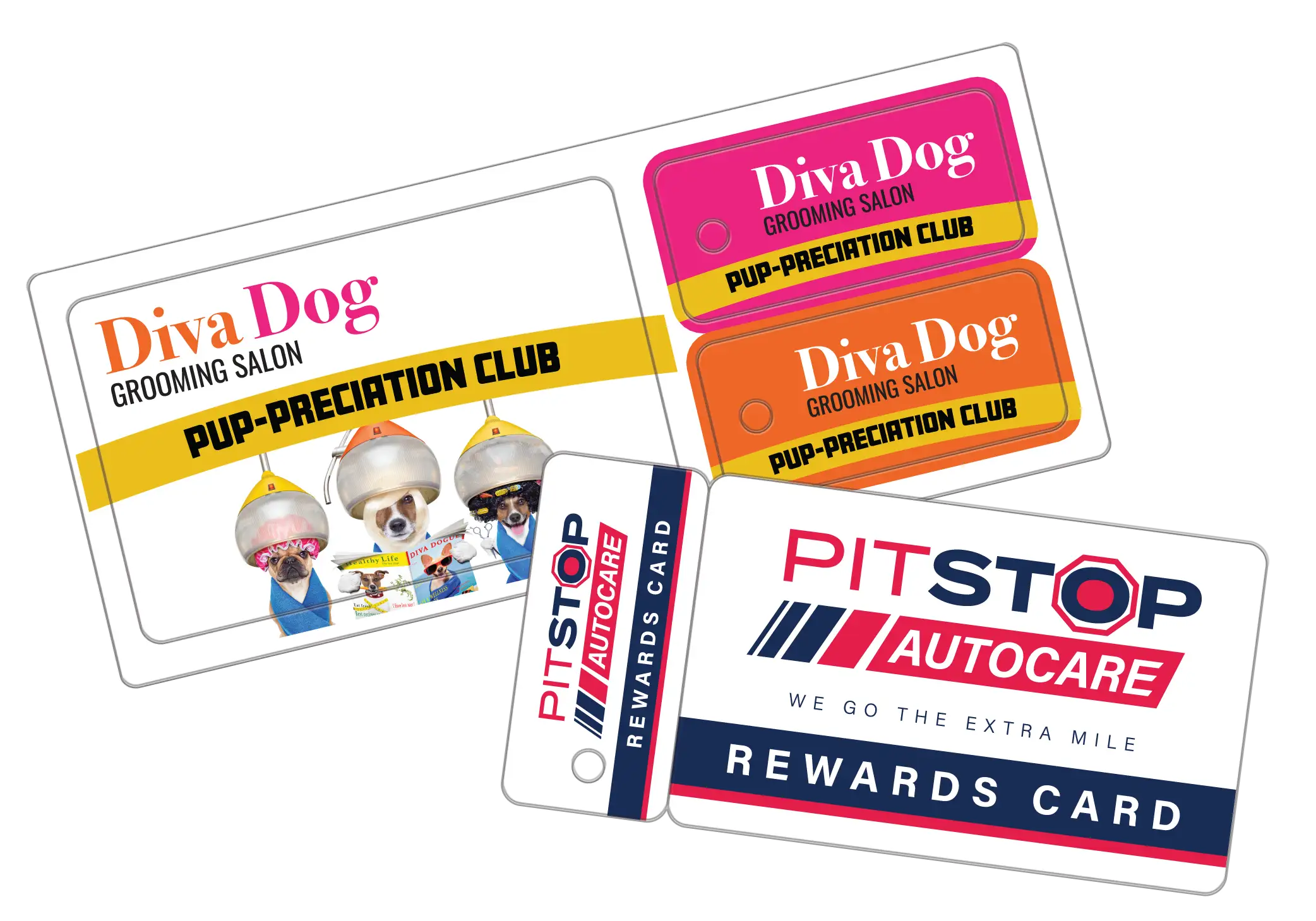
A matching wallet loyalty card and key tag give customers two convenient ways to access a loyalty or membership program.
Digital Apps and Wallet Passes
A digital program may ask customers to enroll with a phone number, email address, QR code, app download, or mobile wallet pass. At checkout, customers may scan a code, provide a phone number, open an app, or receive automatic credit through a compatible payment or POS system.
Digital tools can simplify account tracking and offer delivery, but only if the enrollment and redemption process is easy. A mobile wallet pass can be a middle ground: it gives a customer a digital store card without requiring a separate branded app, although the customer still needs to save and use the pass.
Cost, Setup, and Management
Physical cards usually have a straightforward cost structure. A business chooses material, size, artwork, quantity, personalization, optional encoding, and distribution. Ongoing costs may include replacement cards, program rewards, and any tracking software the business already uses.
Digital programs may involve subscription fees, setup, POS integration, staff training, account support, data-management practices, and ongoing platform costs. Those costs can be worthwhile when a business has a clear plan for customer data, targeted communication, and frequent offer changes.
The right question is not simply which option costs less. It is which option can generate enough repeat business and customer value to justify its total cost and operational effort. A simple local loyalty card program may not need sophisticated technology. A multi-location business with a strong database and a plan for email, text, or mobile communications may gain more from digital tools.
Customer Experience and Adoption
The best loyalty program reduces friction. Customers should understand what they earn, how to access it, and how to redeem it. For some customers, being asked to download another app is itself a source of friction.
Physical cards and key tags work well for customers who prefer a tangible item, visit frequently, pay in different ways, or do not want another app. A key tag can remain on a customer’s key ring and be presented quickly at checkout, while a wallet card provides a convenient physical way to access loyalty benefits.
Key tags also provide a form of repeated physical brand visibility that digital loyalty apps generally cannot. A loyalty app may live on a customer’s phone, but a branded key tag can be seen by coworkers, friends, family, and others whenever the customer’s keys are visible. This added visibility is one reason businesses use loyalty key tags alongside cards as part of their customer loyalty strategy.
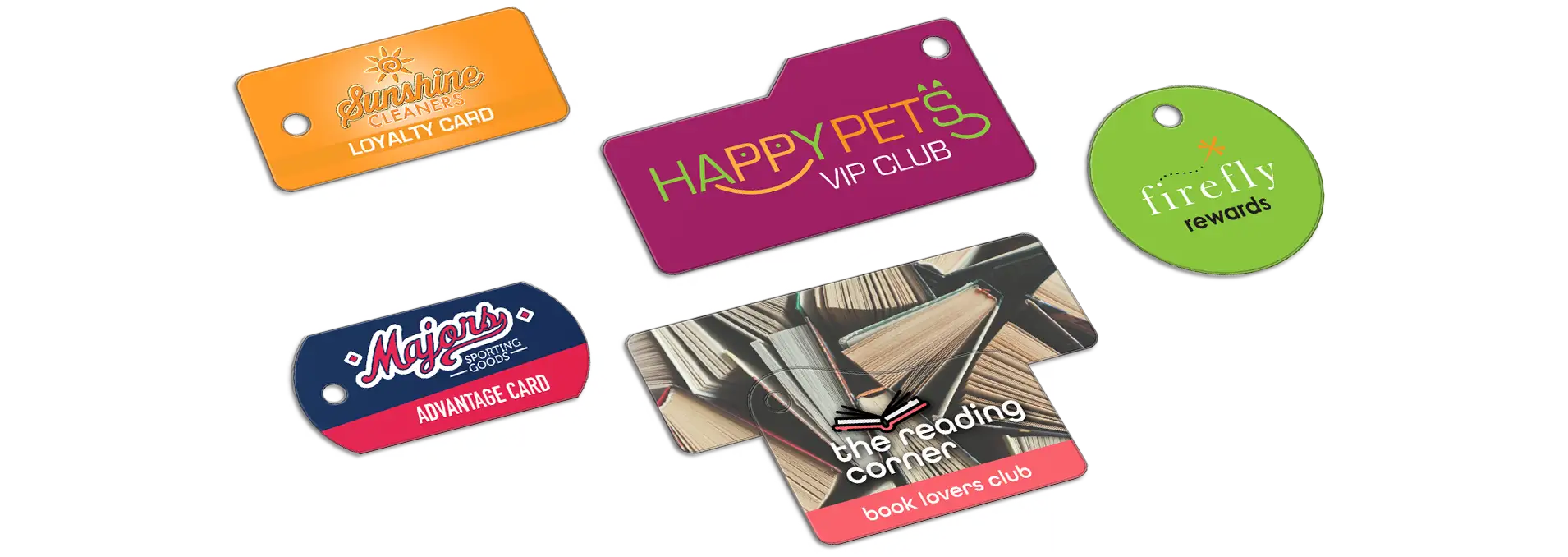
Custom-shaped loyalty key tags can reinforce a business’s brand, product, or promotion.
Digital programs can be convenient for customers who already use phones for payments, accounts, offers, and rewards. Deloitte research emphasizes the importance of easy redemption and relevant value, particularly because consumers may enroll in many programs but engage actively with fewer of them.
Do not assume every customer wants the same experience. The Federal Reserve’s 2026 Diary of Consumer Payment Choice reported that 76% of consumers carried cash in 2025. Cash use does not prevent someone from joining a digital program, but an app-only program can add friction when customers must use a phone, create an account, or enroll digitally. The takeaway is not that cash is better than digital payments, but that a loyalty program should not create unnecessary barriers for customers based on how they prefer to pay or participate.
Data and Marketing Value
Physical cards are not limited to anonymous punch tracking. A barcode, QR code, magnetic stripe, or personalized number can connect a physical card to a compatible customer record. In that model, the card or key tag is the customer-facing access tool while the business and its software provider manage the data.
Key tags also provide a marketing benefit that digital loyalty tools generally cannot: repeated physical brand visibility outside the business. A branded key tag can be seen by coworkers, friends, family, and others whenever a customer’s keys are visible. This gives the business an additional physical brand touchpoint between visits while also serving its loyalty or membership function.
More data is useful only if the business can use it. Without time, staff, or a practical communication plan, a simple program may create more value.
When Physical Cards Make Sense
Physical cards and key tags are often a strong fit when a business:
- Offers a straightforward reward or membership benefit
- Wants a low-friction checkout experience
- Serves customers with varied technology preferences
- Needs a visible member identifier or scannable card
- Wants minimal technology management
- Uses a compatible system that can recognize physical card data
- Wants to issue cards in store, in a welcome kit, or through direct mail
Restaurants, coffee shops, car washes, salons, pet businesses, retailers, clubs, and service businesses can all use physical formats effectively. Read SSI Cards’ guides on turning first-time diners into regulars, loyalty cards for independent grocers, and loyalty key tags at checkout.
SSI Cards produces custom loyalty cards, key tags, and combo cards with barcodes, QR codes, magnetic stripes, and variable data for compatible systems.
SSI Cards can also produce loyalty cards in NVIO™, a biodegradable laminated plastic card option designed for organizations seeking a durable card with a lower-impact material choice. NVIO™ is available for loyalty cards, as well as gift cards and direct mail products. SSI Cards does not offer NVIO™ key tags because key tags require the long-term durability expected from repeated everyday use.
When a Digital App Makes Sense
A digital program may be worth the added effort when a business has multiple locations, needs detailed purchase or visit data, changes offers frequently, or has a realistic plan to use email, text, mobile wallet, or push communications. It also requires staff who can handle enrollment and basic account questions.
An app is not a strategy by itself. The business still needs a clear benefit, a simple enrollment process, relevant rewards, and dependable redemption. Selecting an app because it sounds modern, without a plan for participation and ongoing management, can create cost without meaningful engagement.
Common Mistakes
Avoid choosing technology before understanding how customers and staff will use it. A business may invest in a sophisticated app only to find that customers do not want another download or that staff cannot support enrollment during a busy checkout period. Some customers are also simply tired of being asked to download another app. Downloading an app, creating an account, managing another login, receiving notifications, and keeping another app on a phone can feel like unnecessary friction when a simpler loyalty option would accomplish the same goal. A loyalty program should make participation easier, not create another digital task for the customer.
Other common mistakes include:
- Overcomplicating the reward structure
- Requiring too many enrollment steps
- Failing to train staff
- Making redemption inconsistent or difficult
- Collecting data without a plan to use it
- Replacing a working physical program without a transition plan
The goal is simple: make participation easy and rewarding.
Can You Use Both?
Yes. A hybrid approach can combine the strengths of physical and digital tools. A business can issue a wallet card and key tag linked to a compatible loyalty account, then use its software platform for tracking and opted-in digital communication.
A QR code on a physical card can also connect customers to enrollment, an online account, a promotion, or a mobile wallet pass.
This approach lets businesses add digital capabilities without abandoning customers who prefer a physical option. SSI Cards produces physical cards, key tags, combo cards, and custom formats, but not loyalty software, mobile apps, POS implementation, or rewards administration.
Quick Checklist
Before choosing a format, ask:
- Will customers use it at checkout?
- Can staff explain enrollment and redemption in seconds?
- Do we need detailed customer data and automated marketing?
- Do we have the budget and capacity to manage digital tools?
- Would a wallet card or key tag make participation easier?
- Can our existing technology recognize barcodes, QR codes, magnetic stripes, or member numbers?
- Can we measure repeat visits, redemptions, sales, and customer value?
Key Takeaways
Loyalty cards are not outdated because digital loyalty apps exist. Physical cards and key tags remain useful when customers value simple access, visible identification, and low-friction participation. Key tags also provide repeated physical brand visibility outside the business, while serving as a convenient way to access a loyalty or membership program. Digital tools can be valuable when a business needs data, personalization, automation, or multi-location support.
The right solution may be physical, digital, or hybrid. Choose the approach customers will use, staff can operate, and the business can measure.
SSI Cards manufactures physical loyalty cards, key tags, combo cards, and biodegradable card options for businesses that need the physical side of a rewards or membership program.
Frequently Asked Questions
Are paper punch cards still effective for small businesses?
Yes. They can work well when the reward is simple, easy to explain, and easy to redeem. Success depends on the offer and customer participation.
Is a digital loyalty app worth it for a small business?
It can be when a business needs customer data, automated communication, personalization, or multi-location management. A physical program may fit better when those capabilities are unnecessary.
Will most customers use a digital loyalty app?
Some will and some will not. Offering a physical option can reduce friction for customers who prefer a card or key tag.
Can a business use physical cards and a digital loyalty app together?
Yes. A physical card or key tag can work alongside digital enrollment, QR codes, a mobile wallet pass, or a compatible loyalty platform. Key tags can also provide repeated physical brand visibility beyond the cardholder, as coworkers, friends, family, and others may see the branded key tag when the customer’s keys are visible. This creates an additional marketing touchpoint that a digital loyalty app alone does not provide.
Which format collects more customer data?
Digital programs generally make detailed data collection and communication easier. Physical cards can also connect to a customer record through scannable or variable data.
About the Author
Sean Goade is Executive VP of SSI Cards Marketing & Direct Mail. He helps businesses use custom loyalty cards, key tags, gift cards, and direct mail to strengthen customer engagement, encourage repeat visits, and build lasting loyalty.