
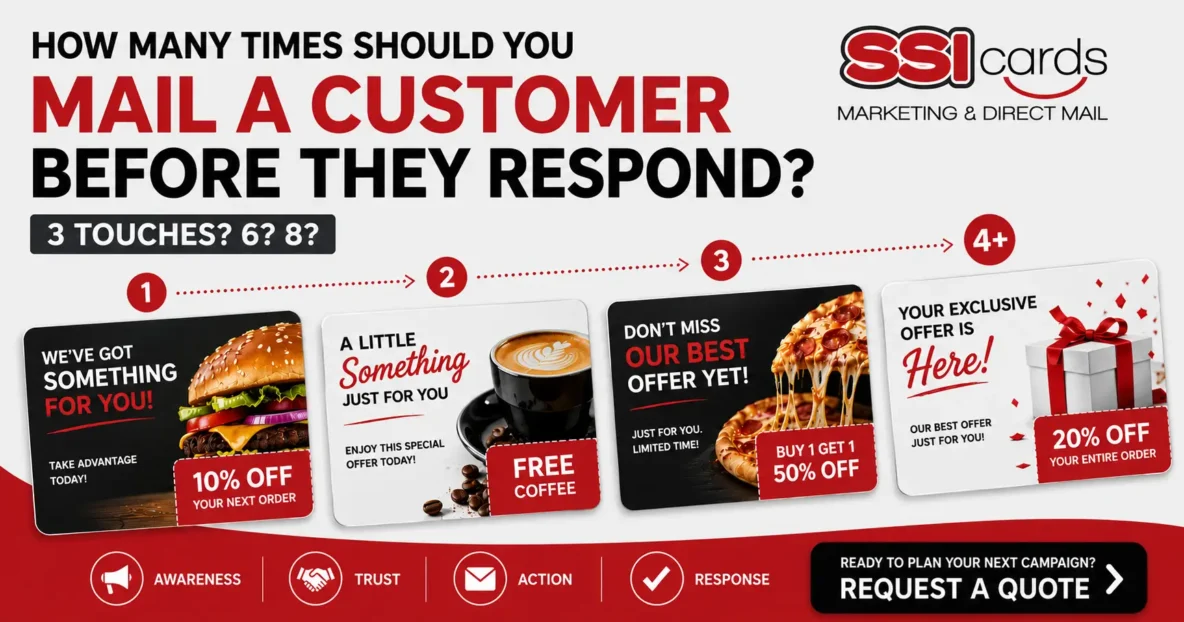
A single direct mail piece can absolutely generate a response. In fact, SSI Cards customers have documented strong redemption from individual mailings, particularly when the audience, offer, timing, and creative are well matched. The question is not whether one mailing can work. It can. The question is whether additional touches can create enough additional response to justify the cost.
For many campaigns, three touches are a sensible starting point when building a repeat-mailing program. Colder audiences, higher-value purchases, and longer sales cycles may justify additional touches, potentially extending the sequence toward six to eight.
A current customer may respond to the first mailing. Another may need several exposures before the business becomes familiar and the offer feels relevant. The right approach depends on the audience, the offer, and the economics of the campaign.
The goal is not to mail someone as many times as possible. It is to create enough opportunities to respond, measure the results, and stop when another mailing no longer makes economic sense.
Key Points
- A single mailing can generate a response. Multiple touches create additional opportunities to respond.
- Existing and past customers generally need less repetition than cold prospects.
- Two to three weeks is a useful starting cadence for many offer-driven campaigns.
- Each mailing should have a reason to exist and give the recipient something new to consider.
- A direct mail postcard can work with email and digital advertising to create additional exposure.
- Retained offers can continue working after the piece leaves the mailbox.
- Stop when additional touches produce too little incremental response.
There Is No Single Magic Number, But There Are Benchmarks
There is no universal number of mailings that guarantees a response. The ANA 2025 Response Rate Report provides current direct marketing benchmark information, but those benchmarks should be used as context for evaluating a campaign, not as a required touch count.
Response benchmarks also help explain why audience temperature matters. Existing customers and other known contacts typically respond differently than people who have never interacted with a business. That difference is one reason mailing frequency should be tied to the audience rather than treated as a universal formula.
The important point is not that a particular response rate tells you to mail three, six, or eight times. Instead, benchmark data provides context for evaluating your own campaign. Start with a manageable sequence, measure the result, and adjust based on actual response.
What the Rule of 7 Really Means
The University of Maryland’s explanation of the Marketing Rule of 7 describes the long-standing principle that people may need to encounter a marketing message multiple times before making a purchase decision.
Seven exposures does not mean seven mailpieces.
A potential customer could encounter your business through a direct mail postcard, email, digital advertising, social media, or another mailing. Those exposures can reinforce one another.
The Rule of 7 is therefore useful for understanding repeated exposure, but it should not be treated as a direct mail frequency formula.
Why Response Builds Across a Sequence
The first mailing may create awareness or generate an immediate response. The next can build familiarity. A later touch may arrive when the customer’s need is more immediate.
The key is to repeat the opportunity, not simply the same message. One mailing can introduce an offer, another can reinforce the benefit, and a later piece can add urgency, seasonal relevance, proof, or a new incentive.
Factors That Change Your Mailing Frequency
The right frequency depends on four basic factors: audience temperature, offer strength, purchase value, and sales cycle.
Existing Customers vs. Cold Prospects
Existing customers already recognize the business, so fewer touches may be enough. A timely promotion or reminder can generate a response without a long sequence.
Cold prospects have more decisions to make. They need to recognize the company, understand what it offers, decide that it is relevant, and develop enough confidence to respond.
That is why current customers, lapsed customers, recent inquiries, and cold prospects should not automatically receive the same direct mail sequence.
Offer Strength and Price Point
A simple, low-commitment offer can generate a response faster than a purchase requiring substantial consideration.
A restaurant promotion or introductory service offer may need fewer touches than a major home improvement project or other high-value service.
Customer value matters as well. If one new customer can generate significant long-term revenue, additional mailings may be worth the investment. For smaller transactions, campaign costs need tighter control.
The lowest-cost direct mail postcard is not automatically the most cost-effective option.
How to Space Out Mailings
For many local, offer-driven campaigns, two to three weeks between mailings is a practical starting point.
That gives recipients time to notice and consider the offer without allowing the sequence to lose momentum.
Shorter spacing can make nearly identical pieces feel repetitive. Longer gaps may make sense for seasonal campaigns or longer buying cycles, but they can weaken recognition between touches.
The cadence should follow the buying cycle, and each mailing should have a clear purpose.
A documented SSI Cards regional grocer campaign mailed selected loyalty audiences over five years and averaged a 25% redemption rate against a 10% goal. That is an individual campaign result, not a typical or guaranteed outcome. Results vary based on audience, offer, timing, creative, list quality, campaign execution, and follow-up.

Super Acclaim™ direct mail campaign for a regional grocer, featuring a custom break-off offer for long-term loyalty marketing.
Signs a Customer Is Warming Up
A response does not always begin with a purchase.
After receiving a direct mail postcard, a customer might visit your website, scan a QR code, use a personalized URL, call the business, or search for the company.
USPS Delivers’ measurement guidance recommends measurable response mechanisms such as QR codes, phone numbers, and personalized URLs.
Informed Delivery can provide another digital touchpoint for eligible recipients by giving them a digital preview of incoming mail. USPS also offers an Informed Delivery Add-On for qualifying 2026 promotions.
These tools help identify interest before the final transaction.
When to Stop Mailing Someone
Set stopping points before the campaign begins.
For cold prospects, establish a maximum number of attempts. For existing customers, consider engagement, purchase behavior, seasonality, and campaign economics.
Always honor do-not-mail requests.
Then watch incremental response. If three touches produce meaningful results but a fourth adds very little, the fifth needs a clear business reason. Continue mailing only when the additional response justifies the additional cost.
How Many Times Is Too Many?
More mail is not automatically better.
The University of Maryland’s Rule of 7 guidance emphasizes relevance, consistency, variation, and timing. Repetition should reinforce the message without overwhelming the audience.
There is no universal number of direct mail pieces per year that is automatically too many. Watch response, engagement, complaints, and incremental revenue.
When additional mailings stop producing enough value, slow the cadence, change the creative, or give that segment a break.
Combining Direct Mail With Other Channels
Direct mail and digital marketing can reinforce one another.
USPS research on omnichannel strategies describes direct mail and digital as complementary channels. A direct mail postcard can introduce an offer while email or digital advertising reinforces it.
A customer might receive a postcard, scan a QR code, see a digital ad, and then respond. Those multiple exposures may reduce the number of direct mail touches needed.
Useful measurement methods include:
- QR codes
- Personalized URLs
- Unique offer codes
- Dedicated landing pages
- Campaign-specific phone numbers
- CRM attribution
- Matched-back sales (tracking purchases back to the mailed customers)
The objective is to understand the entire customer journey rather than measure the mailing in isolation.
Choosing the Right Mail Format
Frequency is only part of the strategy. The physical format can affect how long an offer remains useful after delivery.
For businesses that want a little more than a traditional paper postcard, AcclaimLite™ provides a rigid paper direct mail postcard with detachable break-off offers. The recipient can remove an offer and keep it for later, giving the promotion a life beyond the initial mailbox interaction.
For what is sometimes called a gift card mailer, AcclaimMailer™ uses a laminated plastic postcard (no PVC) with wallet-friendly break-off cards designed to mimic the look and feel of gift cards. The detachable offers resemble gift cards in size and presentation; however, they do not contain stored value unless the specific campaign makes them a stored-value product. The construction is designed to remain attractive through the mail stream and stand out in a mailbox while the break-off offers can stay with the recipient weeks and months after delivery.
Custom shapes and break-offs can also make an offer more memorable when the shape is relevant to the business or promotion.
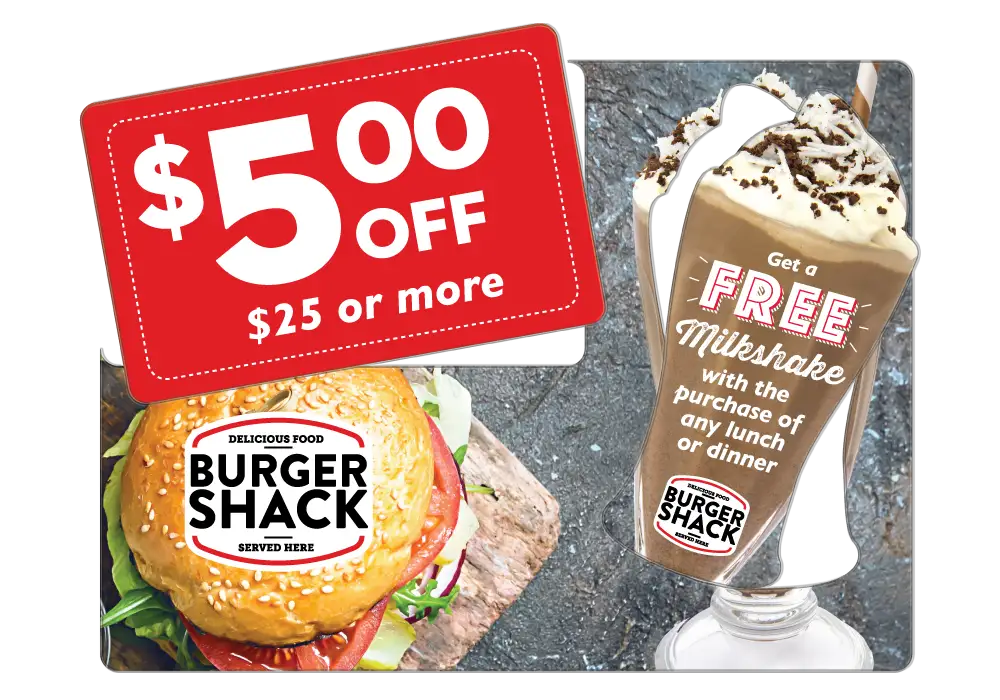
Custom-shaped break-off offer designed to reinforce the restaurant’s brand and give recipients a reason to retain the offer.
NVIO™ provides a biodegradable plastic postcard option with wallet-friendly break-off offers.
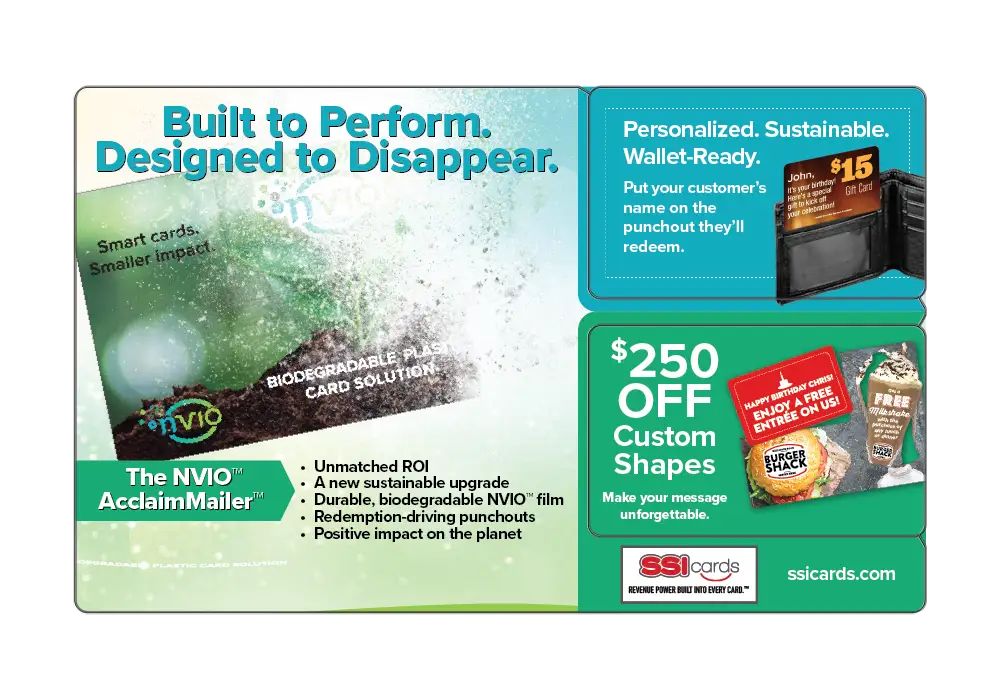
NVIO™ plastic postcard with a wallet-friendly break-off offer, combining retention-focused design with a biodegradable card material.
For campaigns wanting the “no open rate” advantage but have more info and offers than can fit on a postcard, Acclaim10™ laminated self-mailer accommodates up to 10 unique wallet-friendly break-off offers.
All SSI Cards postcard formats can accommodate multiple break-off offers. Acclaim10™ simply provides more space for campaigns that need as many as 10 distinct offers.
Businesses can also build recurring campaigns around customer events with Birthday direct mail campaigns.
A higher-retention format does not guarantee better results. But when documented campaign performance supports stronger response or revenue, the added format cost may make sense compared with simply mailing more low-cost pieces.
Postage is also part of the calculation. A less expensive postcard is not necessarily the most economical choice if a more durable, retainable format produces enough additional response or revenue to justify its higher production cost. The right comparison is total campaign ROI, not printing cost alone.
Want to compare direct mail formats for your campaign? Request a Quote to discuss the right option for your audience, offer, and budget.
A Simple Framework for Planning Your Mailing Sequence
- Define the audience. Separate current customers, lapsed customers, inquiries, and cold prospects.
- Start with one to three touches. Use the first mailing as a test point, then add touches when the potential for additional response justifies the cost.
- Set the cadence. Begin around two to three weeks when the offer and buying cycle support it.
- Give each touch a job. Introduce, reinforce, add proof, create urgency, or provide a new reason to respond.
- Measure before continuing. Track response and engagement after each wave.
For businesses that want to test their cadence before committing to a larger campaign, AcclaimFlex™ provides a flexible, pay-as-you-go direct mail subscription service. Right now you can start with 1 free mailing and 2 free art changes so you can A/B test your offers.
For businesses that want a broader ongoing program, Acclaim Marketing Solutions includes AcclaimFlex™ and Rapid Response, an automated response-targeting service for home repair and service businesses.
Conclusion
There is no magic number of direct mail touches.
For many campaigns, three touches are a sensible starting point. Colder audiences, higher-value purchases, and longer sales cycles may justify additional touches, potentially extending the sequence toward six to eight.
Think in terms of total marketing exposure, not just postcard count. A customer may encounter your business through direct mail, email, digital advertising, and other channels before responding.
Make each mailing useful, space it deliberately, measure the result, and let incremental response determine whether you should mail again.
Ready to plan your next campaign? Request a Quote.
Frequently Asked Questions
How many times should I mail the same customer before they respond?
One mailing can generate a response, so there is no required minimum. For many repeat-mailing campaigns, one to three touches is a practical starting point. Warm customers may respond sooner, while cold prospects or longer sales cycles may justify additional touches.
Is one mailing ever enough to get a response?
Yes. A relevant audience and compelling offer can produce a response from a single direct mail postcard. The question is whether one mailing produced enough return to justify stopping.
How far apart should direct mail pieces be spaced?
Two to three weeks is a useful starting point for many local campaigns. Seasonal promotions and longer buying cycles may require different spacing.
Do existing customers need fewer mailings than new prospects?
Often. Existing and past customers already know the business, while cold prospects may need more exposure before responding.
Does the Rule of 7 mean I should send seven mailpieces?
No. It is a broader marketing principle about repeated exposure. Those exposures can come from direct mail, email, digital advertising, social media, and other channels.
How many direct mail pieces a year is too many?
There is no universal number. Watch response, engagement, complaints, and incremental revenue. Reduce frequency when additional mailings stop creating enough value.
What counts as a sign someone is responding without a purchase?
Website visits, QR scans, personalized URL visits, phone calls, offer-code activity, and other measurable engagement can show that a campaign is generating interest.
Can plastic postcards improve direct mail results?
Yes. While results depend on the audience, offer, creative, timing, and execution, SSI Cards has consistently seen stronger response and redemption from AcclaimMailer™ plastic postcards in customer campaigns compared with traditional paper postcards. More importantly, customers often report stronger ROI, even though plastic postcards typically cost more to produce.
Because postage represents a significant portion of total mailing cost and is similar for comparable formats, plastic postcards do not have to generate dramatically higher response to make up for the additional production cost. A higher-retention format can therefore produce a better return even when fewer pieces are mailed for the same overall budget.
The goal isn’t to mail the most pieces. It’s to generate the most profitable response from the pieces you mail.
By Sean Goade
Executive VP | SSI Cards Marketing & Direct Mail
About the Author
Sean Goade is Executive VP of SSI Cards Marketing & Direct Mail. He specializes in helping businesses leverage high-impact direct mail strategies, gift cards, and loyalty solutions to drive customer engagement, retention, and growth.