
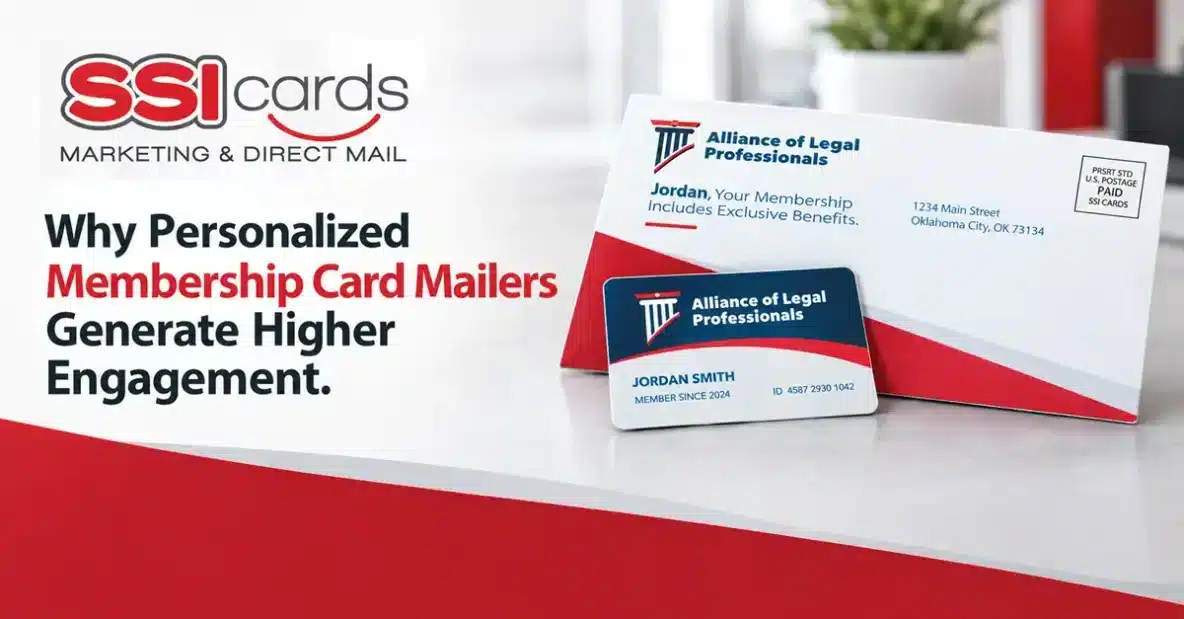
A membership card confirms belonging, and the mailer that accompanies it can turn that moment into action. Personalized messaging, relevant offers, and clear instructions help membership organizations welcome new members, encourage participation, and strengthen relationships.
SSI Cards’ Super Acclaim campaign used personalized plastic postcards and averaged 25% redemption over five years against a 10% goal, reaching 2.5 times its target. This demonstrates the potential of pairing personalized member communications with a compelling offer, such as the $20 off incentive used in that campaign.
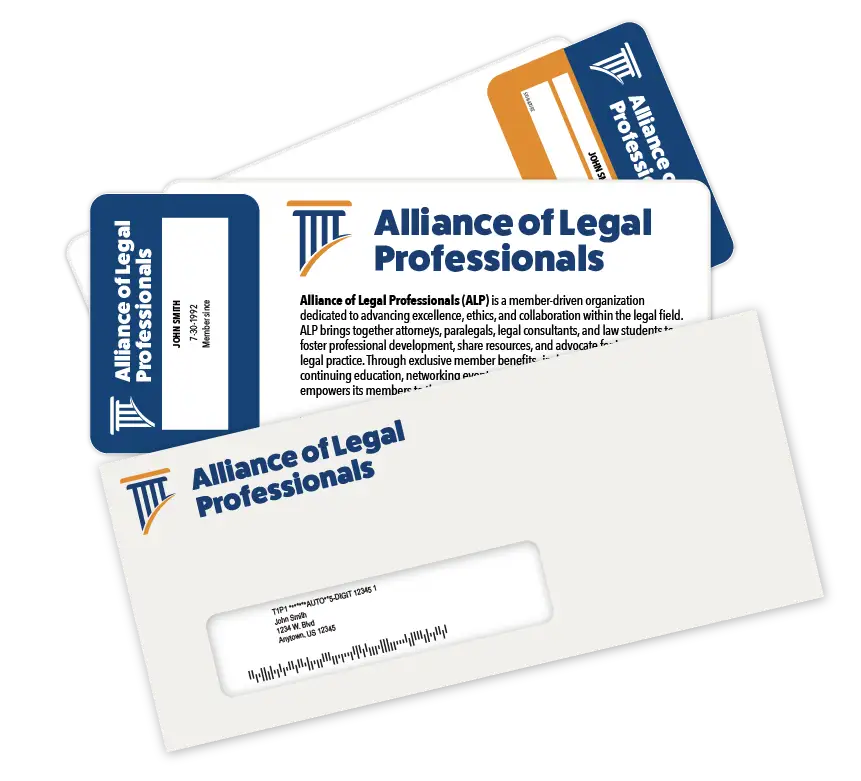
For membership credentials delivered in envelopes, SSI Cards pioneered the integrated one-piece laminated card-carrier mailer format, known as the 1 Card Mailer. Instead of attaching a separate plastic card to a printed carrier, this format integrates the card and mailer into one piece. It eliminates a separate card-to-carrier matching and affixing step, reduces opportunities to mail the wrong card to the wrong recipient, and keeps personalized names, membership details, offers, barcodes, QR codes, and instructions together on one sheet. The mailer itself drives the mailing through a standard #10 envelope with a window.
Variable data printing (VDP) makes that personalization practical at scale. Membership organizations can use a consistent mailer design while changing selected content for different membership types, locations, offers, or campaign goals.
For membership organizations that want a more sustainable credential, SSI Cards’ exclusive NVIO™ landfill-biodegradable laminate can support the same personalized break-off postcards and Card Mailer formats. Members receive a durable, tangible membership credential while organizations retain the flexibility to tailor offers, benefits, and calls to action to each recipient.
Key Points
- Personalization matches offers, benefits, and instructions to recipients.
- Targeted offers can encourage acquisition, onboarding, participation, and renewals.
- The integrated one-piece format eliminates separate card-to-carrier matching.
- Variable data printing supports personalized details, offers, barcodes, and QR codes.
- Accurate data and campaign measurement help organizations assess results.
Why Membership Card Mailers Still Matter
Digital communication is useful for reminders and updates. Physical mail adds a tangible point of contact, and a membership card gives recipients something to keep, carry, scan, or present.
Research conducted by Temple University and the USPS Office of Inspector General found that participants spent more time with physical advertisements and remembered them better than digital advertisements. These findings help explain the value of a tangible mailing that members can keep and revisit.
For associations, healthcare organizations, clubs, nonprofits, gyms, and other membership-based businesses, the mailer can introduce benefits, explain how to use a membership, promote a first visit, or invite the recipient to respond.
A generic message gives everyone the same information, regardless of membership type, location, interests, or stage in the membership lifecycle. Personalized communications can highlight the benefits or actions most relevant to each recipient. The overall design can remain consistent while selected fields, offers, instructions, or imagery change according to available data and campaign rules.
What Personalization Can Include
Personalization ranges from a recipient’s name to messages and offers selected by membership type, location, behavior, or renewal status. Options include:
- Names and membership details: Names, membership numbers, categories, and other approved account information.
- Targeted offers: Introductory incentives, renewal offers, referral benefits, services, or special events.
- Location-specific information: Nearby facilities, branches, providers, or events.
- Tailored instructions: How to activate a card, access benefits, book an appointment, or use a membership.
- Encoded features: Barcodes, QR codes, or magnetic stripes where required.
- Multiple offers: Different promotions or detachable wallet-friendly cards in a suitable mailer format.
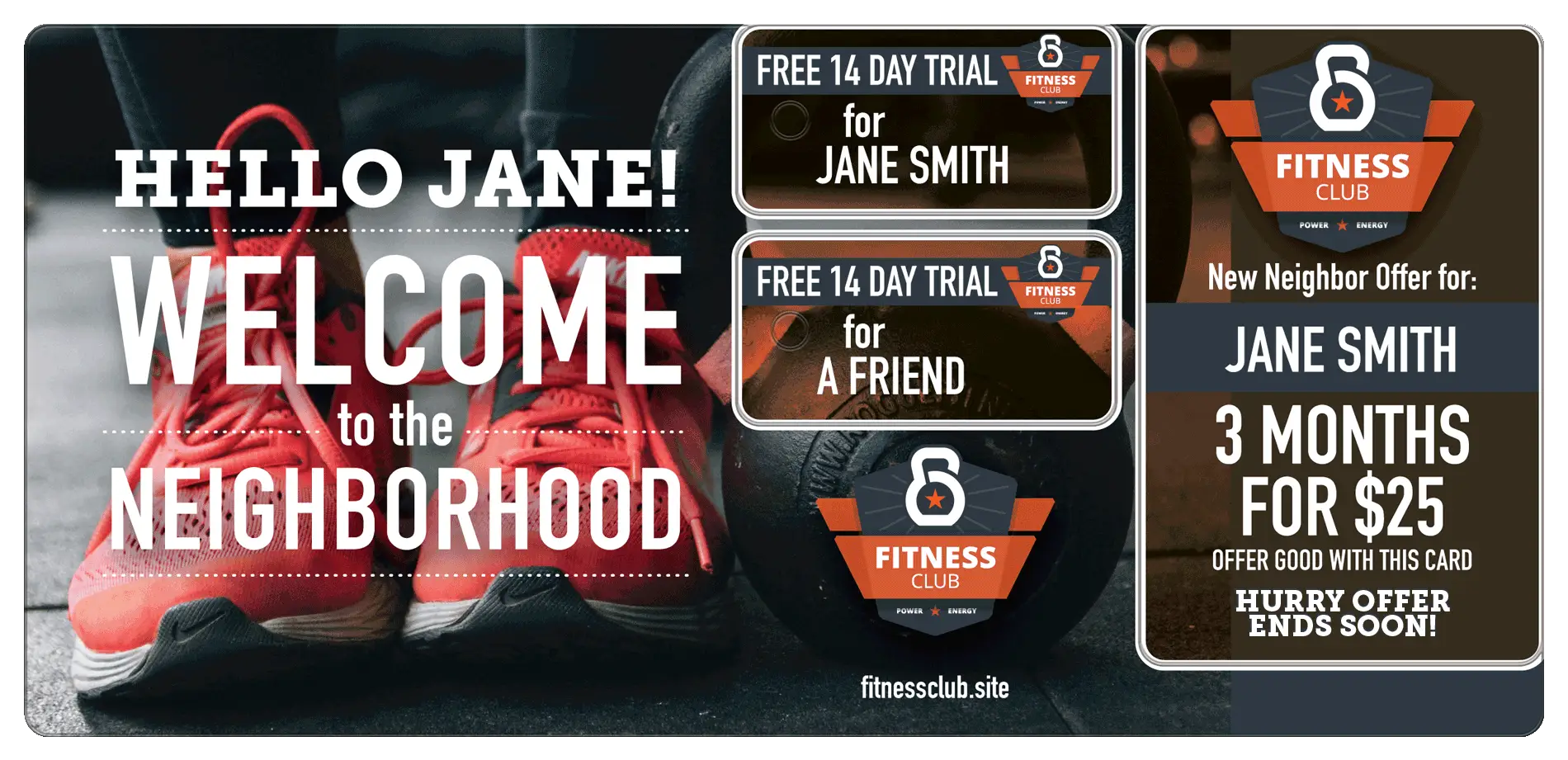
The goal is not to personalize every element. It is to use reliable information to make the communication clearer and more actionable.
Personalize Offers to Encourage Action
Offers give recipients a reason to respond. A gym might promote a guest visit, an association could advertise an event, or a healthcare membership program could highlight a relevant benefit. A retailer or club might offer an introductory incentive to encourage a first transaction, while a car wash could use birthday direct mail to offer local recipients a free wash for their birthdays.
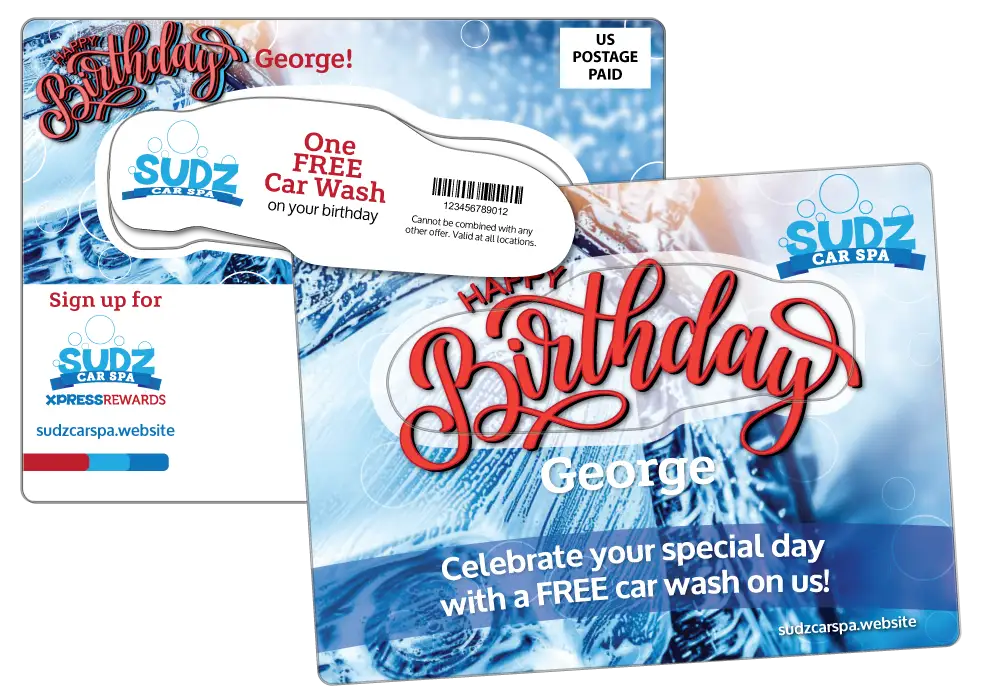
Match the offer to the audience and desired action. New members may need an activation reminder or first-use incentive. Established members may respond to a referral offer, exclusive benefit, or participation invitation.
VDP, including variable images, makes it possible to change selected offer details or messages within a mailing when data and production rules are properly defined. Organizations can also compare offers across audience segments to identify stronger responses.
Make the next step clear. Use simple instructions, a deadline when appropriate, and a QR code or URL if recipients need to visit a landing page. Verify the destination and offer terms. Personalization should be useful rather than intrusive, using authorized information without exposing unnecessary personal details.
Case Study: 453% ROI in Four Months
A 40-location Midwest car wash chain used personalized AcclaimMailer™ plastic postcards featuring a $5 off any wash incentive on its custom break-off in the shape of a race car. The campaign produced:
- 16,505 redemptions
- 1,129 new memberships
- 453% realized ROI over four months
The car wash campaign case study explains how the campaign gave recipients a clear reason to visit and helped the multi-location business attract customers and encourage membership sign-ups. Campaign costs, audiences, offers, and market conditions vary, so these results are not a guarantee. The campaign combined in-person offer redemption with a QR code directing recipients to online membership sales.
Personalization Can Support Retention
Acquiring a member is only the beginning. Organizations also need to help members understand their benefits, use their membership, and see ongoing value.
Personalized mailers can highlight unused benefits, remind members about renewal dates, explain service changes, or promote relevant opportunities. New members may need onboarding instructions, established members may benefit from renewal reminders, and disengaged members may respond to an appropriate invitation or incentive.
Personalization cannot compensate for outdated data, an irrelevant offer, or a confusing call to action. It works best when the message, offer, and next step align with the recipient’s needs.
Case Study: Super Acclaim’s Five-Year Redemption Results
The Super Acclaim campaign generated an average 55% fully loaded ROI over five years, accounting for total program costs, promotions, and redemptions. It used customer purchasing data to target relevant recipients, including shoppers whose spending had declined, with a $20 off a $50 purchase offer. This connected the promotion to each recipient’s relationship with the business rather than treating every customer alike.
The campaign demonstrates how data-driven targeting and a compelling offer can support re-engagement and measurable financial returns.
Looking to attract new members or get existing members more active? Request a quote to discuss personalized offers, card-mailer formats, and production and mailing requirements.
Personalized vs. Generic Membership Card Mailers
Both formats deliver membership credentials and information. Personalization allows messages to be tailored to recipients and helps organizations evaluate performance by audience or offer.
| Factor | Personalized Mailers | Generic Mailers |
| Relevance | Highlights applicable benefits and recipient-specific offers | Delivers the same core message to everyone |
| Instructions | Can vary by membership type or recipient needs | Uses one set of instructions for all recipients |
| Production setup | Requires accurate data, defined rules, and scenario proofing | Usually requires fewer data-dependent checks |
| Measurement | Supports comparisons by offer, audience segment, or message | May provide less detail about which messages drive action |
| Campaign flexibility | Selected details can change within a planned production run | Changes may require separate versions or mailings |
| Best use | Programs where relevance, segmentation, or response measurement matters | Simple communications where one message fits the audience |
Personalization adds data and proofing requirements, but it does not have to be complex. Even using a recipient’s name can make the mailing feel more personal and relevant. For programs with distinct membership categories, offers, or renewal stages, tailoring additional content may justify the extra planning.
Choose a Format That Fits Your Program
The Integrated One-Piece Format
SSI Cards pioneered an integrated laminated card mailer format widely used for membership credentials mailed in secure envelopes across the United States. It combines the card and printed mailer rather than requiring a separate plastic card to be affixed to a carrier and matched to the recipient.
Conventional attached-card production adds a matching step and creates the possibility of a mismatch. Integrating the card and mailer removes that step, helping simplify production and reducing opportunities for the wrong card to be mailed to the wrong person. Even a single large-scale mismatch can create significant replacement, mailing, customer-service, and reputational costs.
Standalone Membership Cards and Badges
SSI Cards also manufactures membership cards and badges with options such as barcodes, QR codes, and magnetic stripes, depending on the application. Choose a format based on how the credential will be used and whether the program needs an integrated mailer or a standalone card.
Material Options for Membership Cards
Material choice affects a card’s appearance, construction, and end-of-life characteristics. SSI Cards offers several options:
- Laminated paper and polyester: A substantial, card-like feel without PVC plastic.
- Teslin®: Synthetic paper used for durable card applications that can support variable data and selected card features. Its laminated construction makes it a durable choice for frequently handled membership key tags.
- NVIO™: SSI Cards’ exclusive landfill-biodegradable plastic laminate and optional magnetic stripe, tested to ASTM D5511-18 and ISO 15985 through an ISO/IEC 17025-accredited laboratory. NVIO can be combined with compatible paper substrates or Bio Teslin.
- Standard and rigid paper postcards: An option for programs that do not need a laminated card format.
Consider card function, expected handling, printing requirements, and environmental objectives when selecting materials.
Plan for Accuracy, Privacy, and Measurement
Personalization depends on data quality. Confirm records are current, required fields are present, and rules for selecting offers or messages are clearly defined.
Proof representative versions, including different membership categories, offer combinations, and edge cases. Verify names, membership identifiers, barcodes, QR codes, and addresses before production.
Use member information appropriately. Limit personalization to authorized data, follow applicable privacy requirements, and avoid printing unnecessary sensitive details.
Plan measurement before mailing. Define success, decide how responses will be captured, and compare results with goals or baselines. Ensure QR codes, landing pages, coupons, and unique offers work and can be measured reliably.
Measure What Matters
Choose metrics based on the campaign objective. Acquisition campaigns may track applications, first purchases, or new memberships. Onboarding campaigns may measure activation or first use. Retention campaigns may track renewals, repeat visits, or continued engagement.
Redemption rate is useful when an offer is involved, but cost per acquisition, revenue, membership value, and renewal performance may also matter. Compare similar campaigns and account for costs when calculating ROI.
USPS Delivers describes methods for connecting direct mail with subsequent actions, including personalized URLs, promotional codes, and matchback analysis. Matchback analysis compares mailing records with later conversions.
Testing different offers or messages across comparable audience groups can help identify what contributes to stronger results. Record the audience, offer, timing, response method, and costs so future campaigns can build on what the organization learns.
Personalized membership card mailers provide a practical way to make communications more relevant, deliver credentials, promote specific actions, and measure results against clear objectives.
Frequently Asked Questions
Why does personalization matter in membership card mailers?
Dale Carnegie, author of How to Win Friends and Influence People, famously wrote that a person’s name is “the sweetest and most important sound in any language.” That principle of personal recognition applies here: a member’s name makes the mailing feel intended for them. Relevant benefits, offers, and clear instructions carry that recognition further, giving members a reason to respond.
What should be personalized on a membership card mailer?
Start with the member’s name, membership level if relevant, benefits, and one clear call to action. Depending on the program, include a member number, expiration date, barcode, QR code, or personalized URL.
Is personalized direct mail worth the extra cost?
Yes, when improved activation, engagement, or renewals justify the additional production and data-management costs. Compare a personalized mailing with a similar generic version to measure incremental results.
What is variable data printing?
Variable data printing changes text, images, codes, or other elements between printed pieces using recipient-level data. It allows organizations to personalize cards and carriers in a coordinated production run.
How can a personalized welcome kit support retention?
A personalized welcome kit helps new members feel recognized, understand their benefits, and take a useful first step, such as booking a visit or registering for an event. Highlighting benefits that match their membership level or interests makes it easier to experience value early. That gives members a stronger reason to stay involved and renew, especially when the welcome is followed by consistent service and relevant communication.
How do you measure the ROI of personalized membership card mailers?
Track activation, first use, engagement, and renewals, then compare results with a suitable control group. Calculate incremental value and compare it with the additional costs of personalization.
Ready to Personalize Your Membership Card Mailers?
SSI Cards manufactures personalized membership card mailers, membership cards, badges, and direct mail formats for acquisition, onboarding, and retention. We can help select a format, personalize offers and messaging, and coordinate production and mailing.
Request a quote for your membership campaign.
By Sean Goade
Executive VP | SSI Cards Marketing & Direct Mail
About the Author
Sean Goade specializes in helping businesses and membership organizations leverage high-impact direct mail, membership cards, gift cards, loyalty cards and key tags, and personalized marketing solutions to support engagement, retention, and growth.