
The Quick Answer
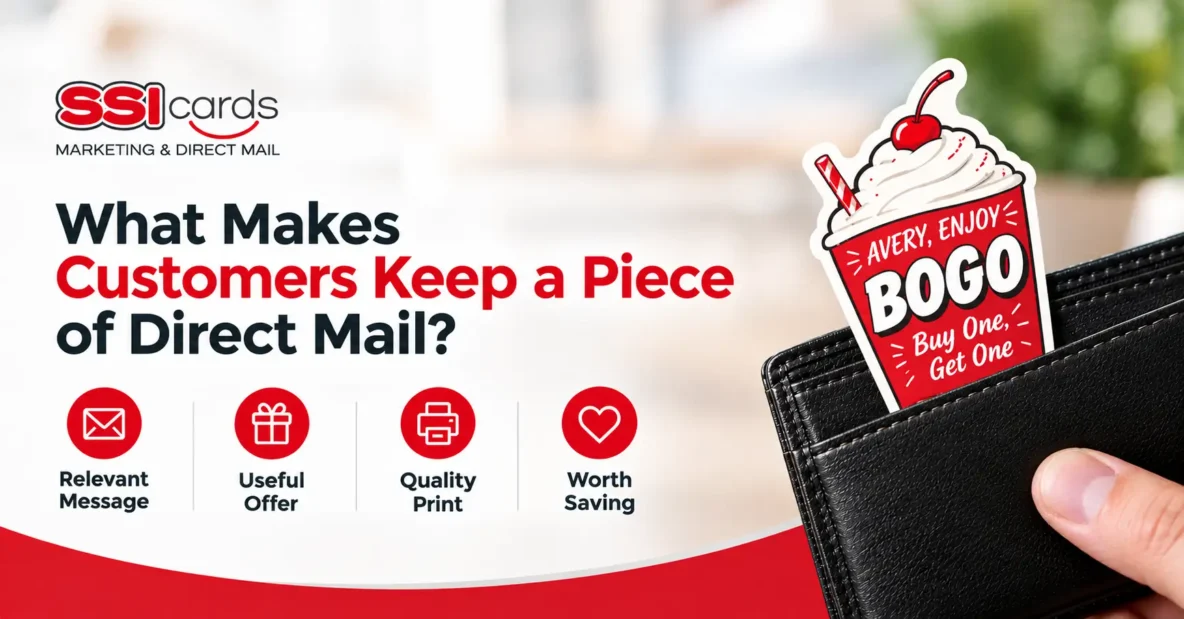
Customers keep direct mail when it is relevant, professional, and useful later. A clear offer, quality print, timely message, and a format that is easy to save can turn one mailbox interaction into a later visit, call, or purchase.
The strongest retention drivers are relevance, usefulness, physical appeal, and timing. The right format depends on the offer, audience, budget, and purchase cycle.
Key Points
- Relevance and timing give recipients a reason to pay attention.
- Specific offers and useful information give people a reason to keep the piece.
- Quality printing and construction can reinforce credibility and encourage handling.
- Break-off offers can extend the useful life of direct mail postcards.
- Match the format to how recipients are most likely to use the offer after delivery.
- Measure delayed response alongside redemption, revenue, cost per conversion, and direct mail ROI.
Why Retention Matters
Retention can affect cost per conversion for businesses of all sizes, including small and local businesses. Printing, production, and postage all contribute to campaign cost. The lowest-cost mailer is not automatically the most cost-effective if another format produces stronger documented results for a comparable audience and offer.
Digital messages may be skipped, filtered, blocked, or quickly scrolled past. A physical piece can remain on a counter, refrigerator, desk, or in a wallet until it is used or discarded. That does not guarantee a response, but it creates additional opportunities for a business to be remembered.
Research by Temple University’s Center for Neural Decision Making and the U.S. Postal Service Office of Inspector General found that physical advertising produced stronger memory and recall effects than digital advertising in the study context. A mailer that stays visible has more opportunities to be noticed and considered later.
What Makes People Save Mail?
People generally save direct mail because it has future value. That value usually comes from relevance, usefulness, credibility, or portability.
Relevance
A message is more likely to be kept when it fits the recipient’s location, likely need, or purchase timing. Personalization can include a name, but it can also mean neighborhood references, local locations, customer segments, past purchases, or seasonal needs.
For example, a landscaping company can send a spring cleanup offer before the season begins. A recipient may not schedule service immediately, but a relevant offer can remain useful until the need arises.
A focused audience is also important. If the offer does not fit the recipient, better printing or a more elaborate format will not make it relevant.
Usefulness
A specific offer gives people a reason to hold onto direct mail. “$20 off a purchase of $50 or more through June 30” is clear. “Great savings” is not.
Coupons, appointment reminders, menus, local-event offers, service schedules, and seasonal checklists can make a piece worth saving. The information should connect naturally to the business.
Expiration dates can encourage action, but they should fit the buying cycle. A restaurant promotion may need a shorter window, while a home-service offer may need more time because the customer’s need may not arise immediately.
Credibility and Physical Appeal
Print quality cannot rescue an irrelevant offer, but poor production can weaken a good one. Blurry images, inconsistent color, difficult-to-read type, rough trimming, flimsy materials, and cluttered layouts can make a business appear less professional.
A strong direct mail design should make the business, offer, value, call to action, and expiration date easy to find. One primary offer and one clear action are usually easier to understand than a piece filled with competing messages.
Recipients also notice how a mailer holds up after delivery. Paper weight, coating, finish, die-cutting, and construction should support the brand and campaign while helping the piece arrive clean, readable, and intact.
Which Mail Formats Encourage Retention?
There is no single format with the best keep rate for every campaign. Choose the format based on what recipients should do after the mail piece arrives.
| Format | Best Use | Retention Consideration |
| Standard postcard | Awareness and focused offers | Easy to see and handle |
| Oversized postcard | More room for content | Larger canvas, but may be folded or bent in delivery |
| Paper postcard with break-offs | Offers and repeat visits | Detachable offers can be saved |
| Laminated plastic postcards | Retention-focused promotions | Durable, wallet-friendly offers with stronger physical presence |
| Calendars, magnets, and reminders | Long-term reference | Kept because it serves an ongoing purpose |
The important distinction is between making something different and making something useful. Novelty may attract attention once. Utility gives a piece a reason to remain relevant.
When Break-Off Offers Fit
A detachable offer can remain useful after the full mailer is set aside. Restaurants, retailers, car washes, salons, fitness businesses, entertainment venues, and other repeat-purchase businesses benefit when customers can carry an offer in a wallet or purse.
AcclaimMailer™ is a laminated postcard with durable break-off cards designed to mimic the look and feel of gift cards. The term “gift card mailer” is sometimes used to describe this kind of plastic direct mail postcard format, but the detachable cards are promotional unless actual stored value is included.
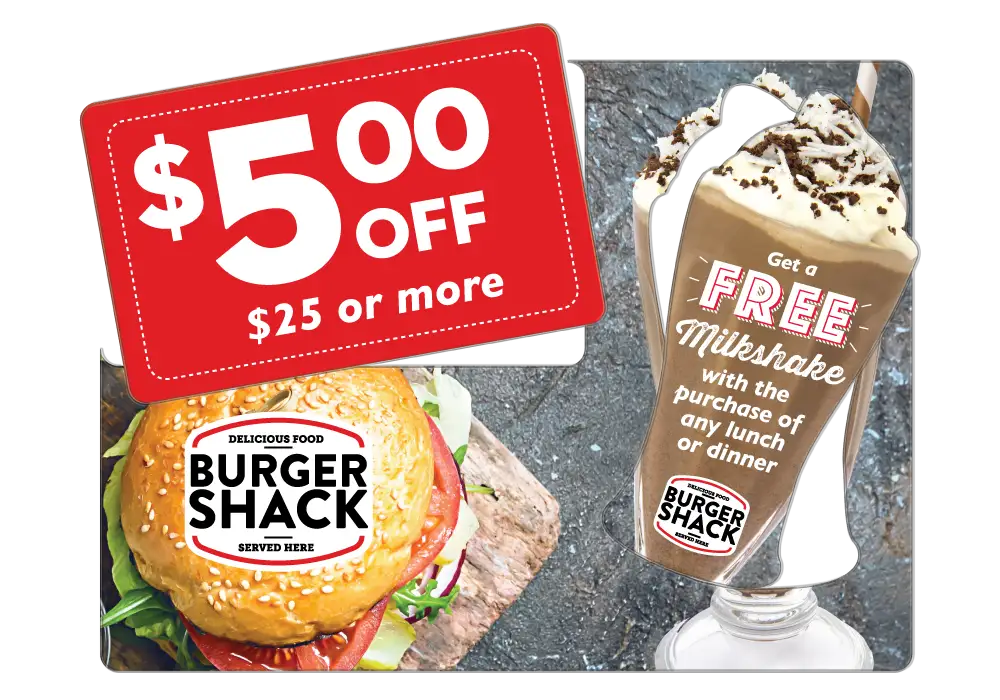
The concept is simple. The recipient sees the full postcard first, then can keep the break-off offer for later use. The format is designed to arrive looking clean and professional through the mail stream, while its wallet-friendly cards can remain useful after the original mailer is set aside.
Custom die-cuts can add physical engagement when the shape reinforces the business or promotion. A pizza-shaped offer can make sense for a pizza restaurant, for example. The shape should support the message rather than exist simply to be different.
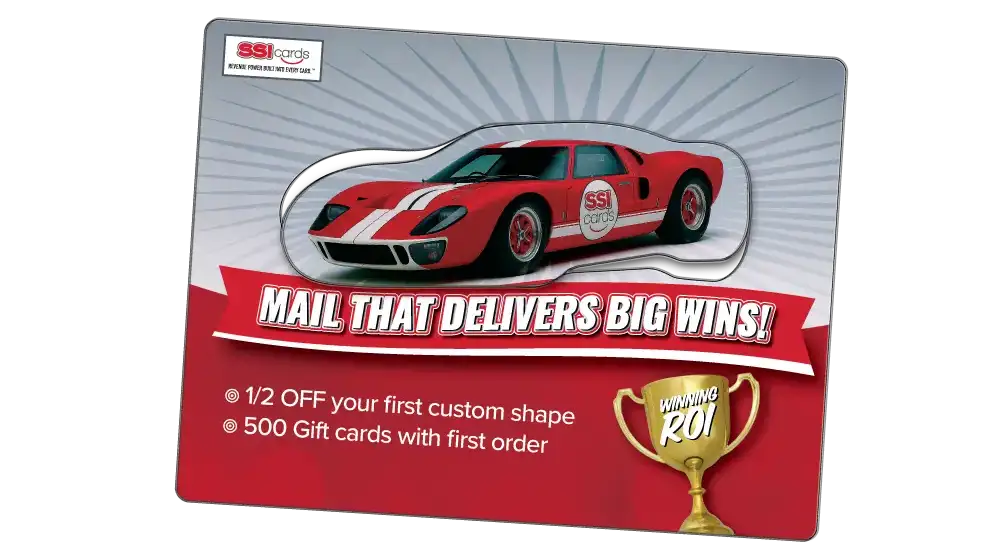
SSI Cards’ car wash case study describes a Midwest car wash campaign that used a custom race-car-shaped $5-off break-off offer and reported a 453% realized ROI over four months, plus a 738% residual membership ROI over 10 months. Custom shapes can be a practical option because the die is typically a one-time, reusable production cost.
Businesses that prefer paper can use AcclaimLite™, a gloss or matte paper postcard format with break-off cards and no plastic. For a biodegradable plastic postcard option with wallet-friendly break-off offers, SSI Cards offers NVIO™.
If retention is an important campaign goal, Request a Quote to compare postcard materials, break-off options, and production approaches.
Timing, Targeting, and Common Mistakes
Even a well-produced mail piece can fail when it arrives at the wrong time. Home-service businesses can mail before seasonal demand begins. Restaurants can align offers with holidays, local events, or slower traffic periods. A neighborhood, service-area, or nearby-location reference can make a piece feel more relevant.
Mail is commonly discarded when:
- The offer is generic or does not fit the recipient.
- The mailing list does not match the business’s customer profile.
- The main message is buried in a cluttered layout.
- Print quality or construction looks low-value.
- There is no clear call to action.
- The offer arrives too early or too late.
The answer is not more graphics or more copy. Recipients should quickly understand who the business is, what is offered, why it matters, and what to do next.
Measure What Happens Later
There is no universal keep-rate benchmark. Retention depends on the audience, offer, format, timing, and campaign purpose.
Establish a baseline and measure what happens after delivery. Unique promo codes, QR codes, campaign-specific landing pages, dedicated phone numbers, and in-store questions can help identify response.
Track results over multiple weeks or purchase cycles rather than judging a campaign only by first-week response. Compare redemption timing, revenue, cost per conversion, and direct mail ROI.
For an A/B test, test one variable at a time. For example, send the same mailer and offer to two comparable audience segments, or send two different offers to similar audience segments. Keep the remaining elements consistent so you can identify what influenced response, redemption, revenue, and direct mail ROI.
Key Takeaways
- Relevance: The message should fit the recipient, location, and buying timeline.
- Usefulness: Specific offers and useful information provide value beyond the initial viewing.
- Quality: Clear design and reliable production reinforce credibility.
- Retention: Break-off offers can give direct mail postcards a useful life beyond the mailbox.
- Measurement: Delayed response, redemption, revenue, and cost per conversion matter alongside initial response.
The most effective direct mail campaign is not necessarily the most elaborate or expensive. It is the one that gives the right customer a clear reason to notice the message, keep it, and act when the time is right.
Frequently Asked Questions
What makes people keep direct mail instead of throwing it away?
People are more likely to keep direct mail when it is relevant, useful, credible, and easy to understand. Specific offers, useful information, and wallet-friendly break-off cards can provide a practical reason to save it.
Does direct mail still work for small businesses?
Yes, particularly when audience targeting, offer, timing, creative, and follow-up are aligned well. A physical mail piece can remain visible after delivery, creating additional opportunities for the recipient to remember and consider the business.
What size or format of mailer gets the best response?
There is no universal best format for every campaign, but in comparable head-to-head campaigns, plastic postcards with break-off offers have produced substantially higher response and redemption than paper postcards. Plastic postcards cost somewhat more to produce, but postage is similar, so the additional production cost can be offset by the higher number of redemptions generated. With the same audience, artwork, offer, and overall budget, the format that produces more redemptions can deliver a lower cost per redemption.
How long do people keep a piece of direct mail?
There is no universal shelf life. A generic promotion may be discarded quickly, while a useful coupon, reminder, reference piece, or wallet-friendly offer may remain available for days, weeks, or months. For example, the car wash campaign described above had measurable response four months after mailing.
What is considered a good keep rate for direct mail?
There is no single industry-wide benchmark. Establish a baseline for your campaigns and compare retention with measurable actions such as redemption, inquiries, visits, revenue, and cost per conversion.
Why can direct mail be more memorable than digital advertising?
Mail creates a tangible object that can be handled, set aside, and seen again later. The research mentioned previously by Temple University’s Center for Neural Decision Making and the U.S. Postal Service Office of Inspector General found stronger memory and recall effects for physical advertising than digital advertising in the study context. For more on campaign economics, see our article on direct mail compared with digital advertising costs.
By Sean Goade
Executive VP | SSI Cards Marketing & Direct Mail
About the Author
Sean Goade is Executive VP of SSI Cards Marketing & Direct Mail. He specializes in helping businesses leverage high-impact direct mail strategies, gift cards, and loyalty solutions to drive customer engagement, retention, and growth.